

In short
You don't have to believe to be a good person — but for me, faith adds a dimension that I could never have reached on my own. It gives me a framework to make more conscious choices, teaches me not to passively endure adversity but to actively find meaning in it, and shows this life as one chapter in a story that continues rather than starting over somewhere. That makes me, year after year, happier.
There are things you only miss when you've lost them for a while. A day without internet feels disturbing, until you realize that you used to live for years without it and it didn't bother you. That's often how missing works: it's only there once you know what you're losing. I think faith follows the same pattern. Those who have never believed usually don't consciously miss anything — and yet I see it all around me: people looking for peace through meditation, for meaning through mindfulness, for connection through all kinds of spirituality. Not because they are unhappyare, but because there is something gnawing that they cannot always name themselves.
I searched for fifteen years before I could name it myself. Not for happiness in itself, but for answers. Why is there suffering? Why do I have to choose? What happens when this is over? I found those answers in the Church of Jesus Christ of Latter-day Saints. Not all at once, and not without my life suddenly becoming problem-free afterwards. But in a way that, year after year, has made me happier. I want to try to explain why — not to convince you that it is true, but to show you what itspecifically brings me.
A framework for choosing
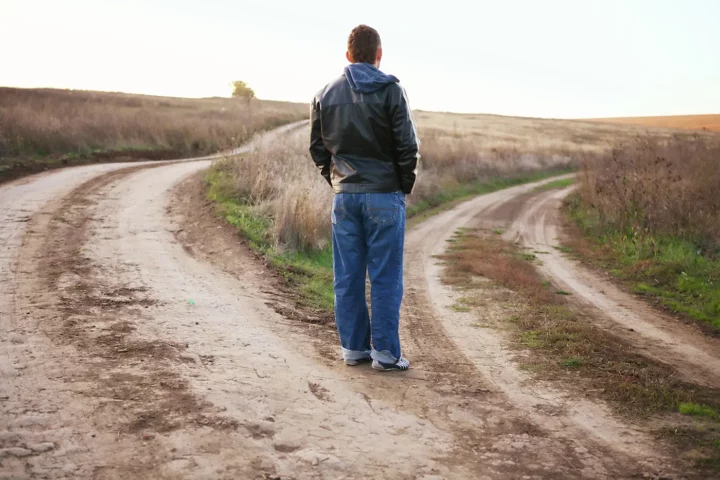
Something I truly believe in is that we are here because a Heavenly Father wants us to be able to return to Him someday and become like Him. That might sound grand, but the plan itself is remarkably simple. It's not set in stone in detail. It's not a step-by-step plan where every choice is already prescribed. The only thing that truly stands central is that we must choose for ourselves.
That freedom to choose is sacred. Even God does not infringe upon it. But freedom of choice does not mean freedom from consequences — we choose the path, not where it leads. And that's the core of why this framework helps me: the better I understand the possible consequences of a choice, the more deliberately I can choose. Without any sight of what's at stake, choosing becomes a gamble. With a framework, it becomes a deliberation.
There's a reason for everything — not 'everything happens for a reason'
This is perhaps the most important distinction I've ever learned to make, and it seems like a wordplay at first glance.
'Everything happens for a reason' sounds comforting, but is actually a dangerous phrase. It presupposes that somewhere, beforehand, a reason was already determined for what happens to you — as if fate wrote a script and you are now walking through it. That thought can paralyze. It can also lead you, in times of serious suffering, to search for a cheap explanation — 'it will be good for something' — which can even feel cruel at the most vulnerable moments.
I prefer to reverse that phrase: there is a reason for everything. Not because that reason is already fixed, but because you can build that reason yourself, in what you make of it. Nobody wrote beforehand why something happens to you. But you can, afterwards, give meaning to how you deal with it. That's not a wordplay — that's the difference between fatalism and freedom of choice, applied to adversity.
For me, that has become an important definition of happiness: truly understanding the difficulties that exist, and yet knowing that there is more ahead.
A secular reader will rightly remark here: I can do that too, without faith? That's right. Giving meaning to what happens to you is not an exclusive right of believers. What faith, in my opinion, adds is not the task of seeking that meaning — everyone has that task — but the building blocks to find it even when it's truly dark. The realization that you are not solely reliant on your own insight, and the perspective that this life is not the complete story, give me something to fall back on precisely at the moments when myown meaning-making falls short.
Comfort, no passivity
That framework offers comfort, but it should never become an excuse to do nothing. God expects us to act within what is possible. And let me be clear: not everything can be overcome. There are diseases that are incurable. There is poverty, there are mental challenges, there are things that just happen to us without us being able to do anything about them. If you experience that and think 'my faith is apparently not strong enough', I immediately set you straight: faith is not an instant cure, and Christ is not a kind of vending machine where you choose the outcome you want.
What it does provide is companionship in bearing it. Not only from people around you, however important they may be, but the realization that you never have to bear this completely alone. Christ is also there for you.
The third dimension
Imagine a world that is completely flat. Everyone who lives there is a flat figure — a hexagon, a parallelogram, a few more complex shapes. Each of those figures can map its own flat world very honestly and very thoroughly. That does not make their map worse. But whoever suddenly gets to know a third dimension gains so much more in one fell swoop than someone who keeps searching within the flat plane — not because the latter thinks less well, but because a part of reality remains structurally unattainable for him, no matter howsharply he perceives.
A convinced humanist might object here that a self-formulated answer is precisely more authentic than an answer you were given. I understand that intuition, but I think it turns things upside down. Authenticity is not in where your information comes from; it is in what you do with it. The fact that I was given certain answers does not make my choice to accept them, to think them through and to live by them any less mine. I still choose for myself. The difference with purely self-formulated answers is therefore not a difference inamount of insight — it is a difference in kind. One builds his map with what is observable within his flat world. The other gains an extra dimension that he himself could never have discovered.
A story with chapters, not a new life
I don't believe that a new life begins after this life, as if this chapter closes and another story starts somewhere. I believe in one uninterrupted existence, with this life as one phase within it. There was already something of me before I came to earth. This here, now, with everything that comes with it — the beautiful and the difficult — is the next chapter. And what comes after this life is not a new book that starts somewhere else, but the same story that continues.
That realization changes something in how I look at today. It's not a reason to take this life less seriously — quite the opposite. Precisely because this is a chapter instead of the whole story, I want to write it well. Not: 'it's bad here, but it will get better later.' Rather: what I learn and become here, I will take with me to the next chapter. That is even one of the most important reasons why we are here. That realization motivates me to always look for the reason why something happens and especially to learn a lesson on how I can do it the nexttime better.
Faith also hurts, and I don't want to hide that
I would be dishonest if I pretended that faith, or a faith community, never causes any pain. It happens. But in my experience, that pain rarely comes from faith itself — usually from the imperfect people who are part of it, or from the moment a life philosophy clashes with a personal choice or experience that felt enormously important at that moment. I don't have all the answers for that, and I'm not going to pretend I do here.
What fifteen years did to me
I haven't become a perfect person. I still have a short temper and regularly have to remind myself to think before I speak. But in fifteen years, I have changed. I seek much less conflict. Where I used to quickly engage in debate, I now more often seek peace. And if I now see my short temper flare up, I will apologize afterwards and try to improve. That's no coincidence — it's the direct result of years of trying to live according to what Christ taught.
An invitation, not a requirement
I say this very consciously: you don't have to believe to be a good person. There are philosophies — Stoicism, humanism, ... — that make people just as good and ethical, and often from the same search for meaning that led me to faith. Faith is not a guarantee of virtue, nor is it a prerequisite for it.
But for me, it has added a dimension that I could never have reached on my own. It gave me a framework for choosing, a way not to passively endure adversity but to find meaning in it, and the perspective that this life is a chapter instead of the whole story. That makes me happier, year after year.
If you want to delve deeper into this than one blog post allows — how I got there myself, and what exactly it did to me — then I wrote a whole book about it: reasonably religious.
Discover more from GeensZins
Subscribe to have the latest posts sent to your email.
