

Briefly summarized
Exhaustion, church history, conscience, and a lack of spiritual nourishment are the four major patterns from Torn, supplemented by a fifth one closer to home: an awkward word or a misunderstood feeling that was never corrected. Listening to understand, showing understanding without agreeing, and openly naming what we prefer to keep silent about, do more than any policy. Leaving remains, with a few serious exceptions, a personal choice. But our task is double: never be the reason ourselves, and provide as much insight as possible so that the choice is well-considered, with the love that remains anyway, whatever the outcome.
When my son Lucas came to church less and less after the death of his grandmother, I waited a long time for the big conversation. It didn't come. Such a loss leaves questions that no one likes to ask aloud: why did a prayer for healing feel so unanswered, and how do you reconcile the promise of an eternal family with a farewell that feels so definitive? I suspect it started somewhere there, although he never said it in so many words. There was no argument, no moment when he said he no longer believed. There was just more and moresilence on Sunday mornings, and one day he was no longer there. He never became anti. He never speaks ill of the church, and certainly not of the people in it. He even listens patiently when I bring it up from time to time. I love him unconditionally, I perfectly understand why he thinks the way he does after what happened, and at the same time, I can't help but try, cautiously, from time to time, if there's still a spark left that wants to grow. That tension — fully accepting someone as he is, and yet continuing tohope that faith will one day return — is, I think, something that many families in our church know today.
Four waves
A book was published in the United States this year that is precisely about that: Torn, by Jeff Strong, a former top manager at Procter & Gamble and Johnson & Johnson, and himself a bishop and mission president. His motivation was also personal: three of his five children left the church at some point. This led him to set up a large-scale study, based on more than twenty thousand surveys and interviews, into why people stay away. His research distinguishes four patterns, which he calls waves. They constantly overlap in practice, but it is worthwhile to look at them separately.
The first wave is lifestyle. This is not the wave of doubt, but of exhaustion. People who go this way do not ask themselves if the church is true, but if they can still endure it. Overfilled callings (the voluntary tasks and functions you take on within the community) on top of family and work, mental pressure fueled by guilt and perfectionism, a culture where being constantly busy is the norm and rest almost feels like failure. What people say here is rarely theological: they felt controlled, they were worn out, they no longer had room for theirown decisions. In itself, this is rarely the reason why someone definitively leaves. It is more often the first crack: the place where resistance to everything that comes after begins to crumble.
The second wave, and immediately the largest, is church history. People encounter historical, doctrinal, or institutional information that conflicts with what they had once learned or assumed. Polygamy, translation issues surrounding the Book of Mormon or the Book of Abraham, the fallibility of prophets, aspects of temple endowment (the solemn ceremony members receive in the temple). The interesting thing, and the point that has stuck with me the most, is that it is rarely the historical facts themselves that cause the most pain. It is the question that comes afterwards: who can I still trust if this has beennever told to me? People going through this wave can certainly live with complexity and imperfection. What breaks them is the feeling that they have built upon a simplified narrative, and that the institution that told the story knew it.
The third wave is about social issues and conscience. It's not: is the church true. It is: even if it were true, can I still support this? The treatment of LGBTQ people, financial transparency, tithes as a condition for baptism and temple attendance, inequality between men and women, the way abuse has sometimes been handled. What distinguishes this wave from the previous one is that it is not a search for truth, but a matter of conscience. People don't say: I no longer believe. They say: I can no longer subject my conscience to this, and as long as loyalty demands silence, it weighsloyalty too heavily.
The fourth wave is ecclesiastical experience, and perhaps the quietest of the four. People continue to believe in God and in Christ, but the church itself no longer nourishes them spiritually. Worship that feels procedural instead of alive. More emphasis on obedience and temple attendance than on other parts of the gospel. Leaders for whom obedience outweighs care. What people are saying here almost sounds like hunger: I no longer felt the Savior, I was spiritually starved. This is often the decisive wave, precisely because it is not about claims or policy, but about the question of whether there is still something to be found that nourishes.
None of these four waves exists in isolation. Those who become fatigued by wave one become more vulnerable to the questions of wave two. Those who let their conscience speak through wave three often also find themselves facing wave two, and feel extra disappointed in wave four if their concerns are dismissed. These are not four separate explanations; rather, they are four areas where sincere people clash with an an environment that struggles to adequately address complexity, conscience, and doubt.
One thing I do want to say right away. Strong's survey was mainly disseminated through online communities of current and former members, places where people are already actively engaged with questions of faith. The percentages associated with each wave therefore mainly say something about who took the trouble to complete a long questionnaire, not necessarily about the church as a whole. Moreover, one wave is missing: people who do not leave after a crisis, but simply drift away, without storm and without a breaking point. By definition, this group never expresses itselfout loud, and therefore never appears in this type of research. Nevertheless, as a bishop, I recognize each of the four waves that are present. They are useful, as long as you read them as patterns and not as exact statistics.
A fifth wave, closer to home
Torn is, it must be said, a very American book about a very American church culture. In Flanders, and I suspect in the rest of Europe, I myself see a pattern that nowhere really gets a place in Strong's four waves, and that in my experience occurs at least as often as the other four combined: a conflict, or perhaps that is already too strong a word, with another member.
A wrongly chosen word during a lesson. An explanation that came across as abrupt or awkward. A lack of warmth at a moment when someone needed just a little extra. And sometimes, even worse, the same but from someone in authority: a bishop, a quorum leader. Usually, there is no malice behind it, although there are also stories where that is the case: deliberate abuse of authority, gossip, transgressive behavior. That exists, and it deserves no excuse. But whether it was awkwardness or something more malicious, the impact on the person it happened to weighsoften just as heavily on them. Sometimes it's one moment that sticks, but usually it's a sum: the others, over a longer period, each contributing a little to the same feeling. Not out of protest. Simply: Sunday becomes a threshold instead of an invitation, and that threshold gets a little higher every week.
What sets this wave apart from the other four is that it is rarely about the church itself, and almost always about others in the church. That doesn't necessarily make her easier to recover than the rest. There is no doctrine to revise, no policy to change, but that does not mean the solution is within reach. It requires action from individuals, and it is extremely difficult to see your own fault, especially if the hurtful behavior was well-intentioned: no one likes to recognize themselves in a story in which they hurt someone without meaning to. And the responsibility does not lie solely with those who offended. Even those who stayed away must be willing to forgive, otherwise the threshold will remain, even if the other person has long since regretted it. What this wave mainly requires is not recovery afterwards, but prevention in advance. That starts with simply being aware of it: knowing that this plays a role, instead of thinking that people only stay away for major, principled reasons. And it starts with not being afraid of two simple words: I'm sorry. A leader who dares to admit in time that he went about it wrong will do more to stem this tide than any policy ever could.
Strong's third wave, conscience, and social issues, I see these increasingly emerging among young people, especially in the years when they transition from adolescent to adult and for the first time truly begin to form their own opinions on these themes. This is not society's fault; I don't want to suggest that. But it doesn't help that the outside world often immediately dismisses anyone who thinks differently, on both sides of every debate. Young people who, at that vulnerable moment, try to take their own nuanced position,often end up standing alone: too progressive for one side, too conservative for the other. And young people don't like to be alone.
Listen with love
The second part of Strong's book is about how you, as a member, parent, or leader in the church, deal with this. He provides concrete steps for this, and they are not bad. But as a bishop, I prefer to say it differently, based on what I myself have learned over all these years.
It starts with listening. Not listening to answer, not listening to keep the right scriptural counter-argument ready, but listening to understand. Most people who doubt don't need someone to solve their questions. They need someone who doesn't immediately jump in to fix things. If someone sits opposite me and says they no longer feel it, or that they can no longer reconcile something with their conscience, my first task is not to argue against it. My first task is to show that I reallyhear what is being said.
Then comes understanding. Not the kind of understanding that says: I get that you're having a tough time with it, but actually, I also understand why someone comes to that conclusion, even if I myself come to a different conclusion. That's a bigger difference than it seems. It's one thing to acknowledge someone's difficulty. It's another thing to admit that their reasoning, given what they've experienced, simply makes sense, even if I myself arrive somewhere else. With Lucas, that's exactly what I've had to learn. His reasoning after the loss of hisgrandmother is consistent and honest for him. I don't have to share them to understand them.
And then, perhaps the most difficult thing: letting go of the illusion that I have control over this. God forces no one. He invites, and lets people choose, even if that hurts Him. There is a verse in Moses that says God wept when He saw how His children turned away from each other and from Him (Moses 7:28). If God Himself bears that pain without forcing, who am I then to think that with the right argument, at the right moment, I can talk someone back? That doesn't mean I stop trying. It means that the trying itself does not come fromcontrol, but from love that asks nothing in return.
That is also why I think the well-known text from Doctrine and Covenants is still the best compass: it is not commendable to be forced in everything, for the power is in them, whereby they are agents unto themselves (D&C 58:26, 28). That power applies to me as much as to Lucas. I can try to be the environment in which faith can grow. Ultimately, it grows itself.
There is one more pastoral lesson I want to add to this, and it is perhaps the most important: working preventively. If we know these patterns (Strong's waves, and the fifth, closer to home), then the temptation is great to silence them out of fear. Not speaking about doubt, not speaking about the pain that an awkward word can cause, not speaking about the tension young people feel around social issues, for fear that we would thereby evoke the problem ourselves. I think it works the other way around. He who these patternsnever names, leaves someone alone in the cold when it happens to them. But whoever knows in advance that there is room for doubt, that other viewpoints exist and are understood, that an awkward word from a leader is not a reflection of how God looks at them — that person stands stronger when the wave, whatever it may be, finally reaches them. Prevention does not start with a solution. It starts with openly naming what we would rather keep silent.
I want to be honest here about the limits of what I can do as a bishop. In wave three, it often concerns policies decided far above my ward: financial transparency, the treatment of LGBTQ+ individuals, tithes as a condition for temple visits. No matter how much love and understanding I show, that doesn't change the policy itself. For those whose conscience is precisely stuck on that, a listening ear at the ward level does not resolve the tension at a worldwide level, and I will not beat around the bush. The only thing I can offer is that no onehas to bear the burden alone, and that I dare to say without fear that I have no problem with those questions to still be a full member of this church.
What the book did and did not give me
For Lucas has Torn actually taught me little. Not because the book is bad, but because what I needed for him, no book could give me: just keep loving, keep listening, and keep the door ajar without pushing. I already knew that before I read the first page.
What it did give me is something else: a useful framework to re-evaluate and organize my own experiences and lessons as a bishop, and to place them higher on my own priority list. The distinction between the waves, Strong's four, and the fifth that I add here myself, helps me to recognize faster where someone stands, and thus also to listen better to what is actually being said instead of what I expect to hear.
However, I honestly want to say that I find the book, as a whole, too one-sided. Strong repeatedly places the responsibility on the culture of the church, as if people primarily leave because we as members and leaders fall short. There is truth in the fact that we often fall short. I do not deny that, and this piece doesn't accidentally start with it. But it's too easy to let the entire explanation stop there. Leaving remains, ultimately, in most cases a personal choice. Although I realize that word sounds too light for some.Whoever leaves after deeply hurtful behavior, after abuse, or after years of exclusion, rarely experiences that as a free choice: it rather feels like a necessary escape, to protect themselves and their spiritual well-being. I do not want to hide that distinction. But it changes nothing about where our responsibility lies: the heavier the circumstances were for someone, the more urgent our task to never be the reason for it ourselves.
I believe our task, as church and as family, consists of two things. First: ensure that we are not the reason. That we don't push anyone away by our own shortsightedness, our own impatience, our own fear of not knowing the answer. And then: give the other as much insight as possible, so that he or she can make a well-considered choice: not a choice based on half-information or old pain, but an honest, mature choice. And whatever comes of it: let them know that love remains, unconditionally, no matter how that choice turns out.
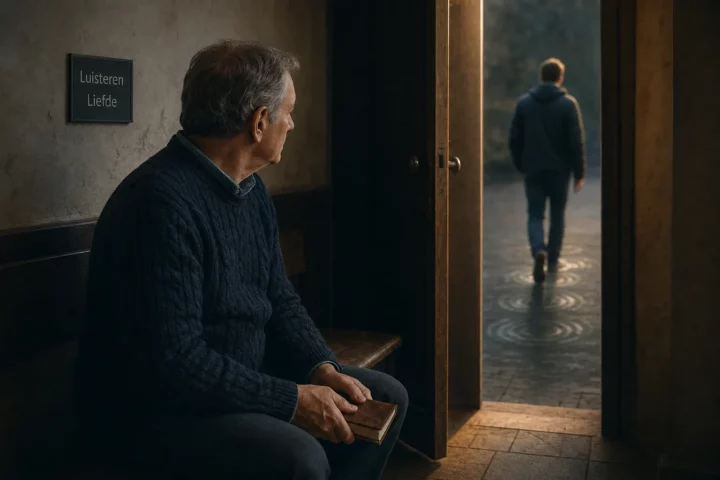
That is, I think, the only thing I can still give Lucas. Not the answer. Not the church. Just: that he knows the door remains open, and that, whatever he chooses, he remains my son — with all my heart.
Discover more from GeensZins
Subscribe to have the latest posts sent to your email.

Constructive article. Thanks for sharing .