

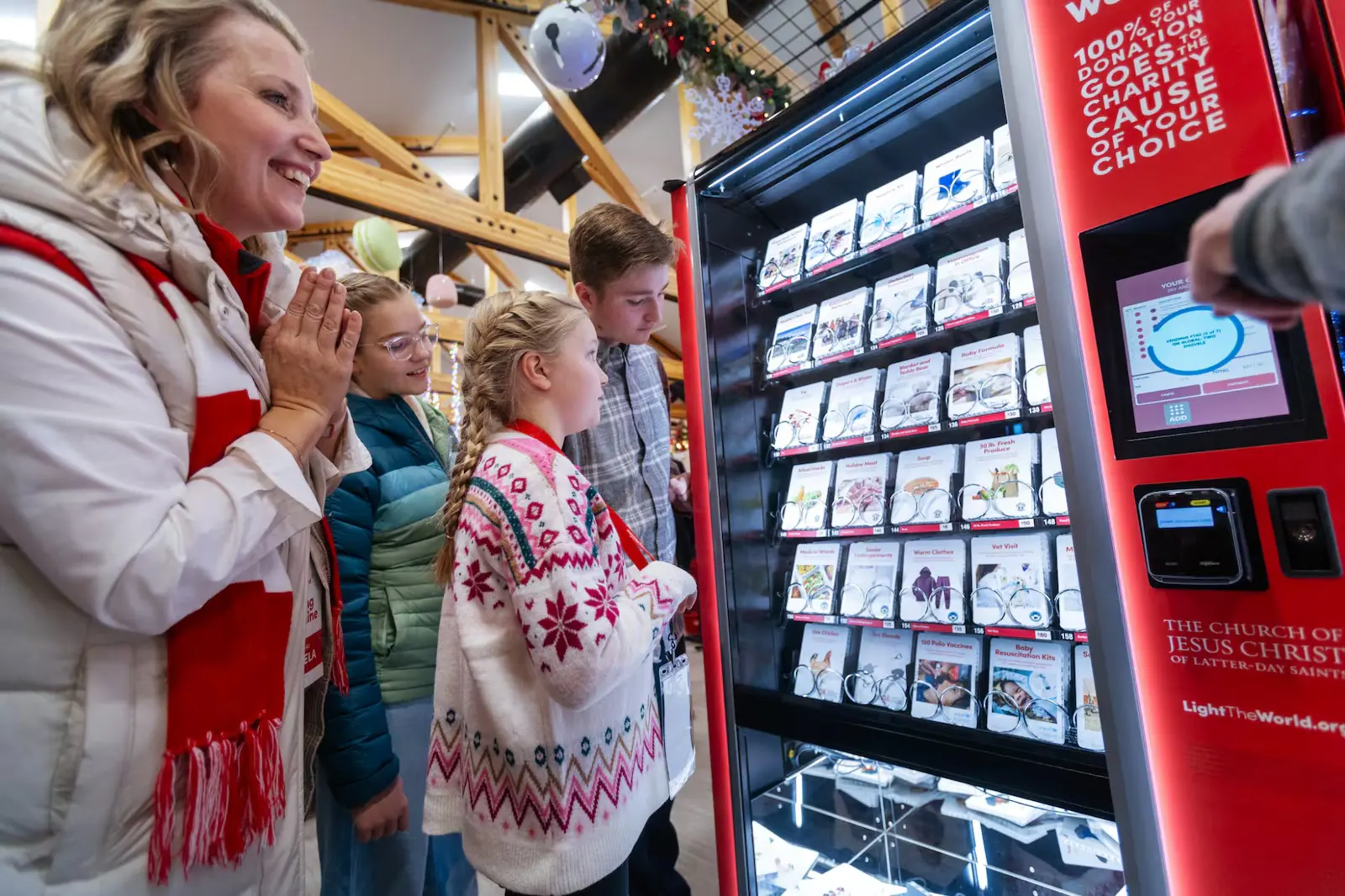
The Christmas season is just around the corner, and for me, that means not only a time for family and reflection, but also the moment when The Church of Jesus Christ of Latter-day Saints launches its ‘Light the World’ initiative. A crucial and inspiring part of this for me are the Giving Machines.
A simple idea with a gigantic impact
What are these Giving Machines, you might ask? Imagine the classic, bright red candy vending machine, but instead of buying chocolate or chips, you donate to charities. With a simple swipe of your bank card, you can buy a chicken, sports equipment, hygiene products, or even vaccinations for children. It's a brilliant, tangible way to celebrate the birth of Jesus Christ by serving others.
The machines are a huge success. Since 2017, through this initiative, nearly $50 million donated. These donations are converted into tangible aid. To give you an idea of the scale: in 2024, 2 million meals were provided, 500,000 children were vaccinated against polio and measles, and 125,000 refugees received emergency food packages. That's giving at its best, without the hassle of a traditional collection.
A worldwide record
This year (2025), the Giving Machines are expanding for the ninth consecutive year. The large red vending machines can be found at more than 126 locations In 21 different countries. That's an absolute record! For the first time, they are even going to South America. Nine new countries have been added, including Argentina, Brazil, Chile, El Salvador, Italy, Japan, Spain, and Thailand.
From the United States (with locations in cities like New York City and Salt Lake City) to Australia (Adelaide, Melbourne, Sydney) and Europe (Barcelona, Birmingham, London, Rome, Vienna), the machines are everywhere. The scale of the operation shows the power of a simple, positive message.
The harsh reality of suspicion
This brings me to a personal, and unfortunately, less rosy experience. A few years ago, when I was the national director for communication for the church, I tried to bring a Giving Machine to our own country. Seeing the good these machines did in other countries, I thought: we must have this here too. This is pure, selfless charity.
However, my search for a suitable public location hit a wall. No local government was willing to provide public space for the machine, and this, in my firm belief, had to do with the origin of the initiative: The Church of Jesus Christ of Latter-day Saints.
Even when I switched to private spaces — commercial centers where thousands of people pass daily — I got no response. The fear of 'reputational damage' or, strangely enough, 'vandalism' proved too great.
An idiotic distrust
It's truly idiotic. Here's an initiative that raises millions for the most essential needs, yet in some parts of the world, it encounters distrust. Why? Because it says 'Church' on it.
Look at other initiatives that encourage the public, such as the 'Glass House' or other charities. They receive broad, unconditional support from governments, media, and businesses. And rightly so! But as soon as it concerns an initiative of our church, a smokescreen of suspicion appears among some people. They are afraid. Afraid of faith, afraid of an organization they don't (fully) know, and afraid of what the neighbors will think.
I know all too well that every organization carefully guards its public perception. But if pure charity is refused out of fear of an organization that only tries to help, then there is something fundamentally wrong with the public dialogue about faith.
Visibility as medicine
My conclusion is that as members of our church, and perhaps as believers in general, we should be more visible in public life.
When I read about the successes of the Giving Machines in all those hundreds of cities, they are successful thanks to the local members who commit themselves, seek partners, and show their face. The Giving Machines are not an anonymous action; they are an extension of what we believe and what we do: caring for our neighbor.
Perhaps we should show the suspicious government, the concerned shopping mall owner, and the skeptical citizen who we are. We tell others about our faith, we are always missionaries, and yes, we are members of a faith community. But above all, we are just people who believe in charity and who, like everyone else, want to do their part.
The Giving Machines are proof that we pursue nothing other than helping people. Hopefully, in the near future, we can also display this simple and powerful proof closer to home. Because the joy of giving should know no boundaries or prejudices.
Discover more from GeensZins
Subscribe to have the latest posts sent to your email.
