


I'll warn you right away: this will be a longer-than-average post. I had hoped to post regularly in between about how I went from purchasing my Tesla Model S to delivery, but I decided to collect all the information and post it all at once. With this post, I hope to help other Tesla-would-be-buyers with some of the decisions I made and what I learned. I'll probably drive some Tesla fans up the wall with this blog post, but I won't shy away from the criticism, even though I also consider myself atrue Tesla fan.
Do you also want to buy a Tesla and get a €1000 discount? Then use this link before October 15, 2016.
Content of this article
- Choice of model
- Total Cost of Ownership
- Delivery period
- How to charge?
- Choice of the charging station
- Range Anxiety
Choice of the version of my Tesla Model S
I've been keeping an eye on Tesla for years. I think I was one of the first visitors to the Tesla Store in Aartselaar. But years ago I bought an Opel Antara, one of the first units delivered in Europe. I was happy to have a brand new model until I had to drive it. Afterwards, I decided that for cars I would do the same as for software: version 1.1 or 1.2 must be available before I buy it.
So I have been following for a long time forums and no matter how you look at it, the Tesla Model S has had teething problems. Ranging from retracting door handles that scratch the windows to drive trains coming loose and cars simply coming to a standstill. All problems that I repeatedly heard complaints about in those first years. Since early 2015, I noticed that these complaints no longer seemed to occur and I felt confident enough to consider a purchase.
So this summer I went back to the Tesla Store in Aartselaar, with a lot of questions about range, charging options, and especially the costs and taxes related to electric cars.
Assembling the car was actually quite simple. The choice options at Tesla are not those endless wish lists and combinations and packs like at Audi or BMW, but are simply clear. Car version: because of my kilometers, without a doubt the largest battery, together with the extension: 90kW. Single motor or dual motor? A no-brainer: 4-wheel drive is my thing. I am not a sporty driver, pure rear-wheel drive is something I have driven before and it is not my thing. Plus our family's preferencefamily to go on holiday to Sweden, also in winter... So clear the dual motor and in one go also the winter package added so that the children can also have a warm bottom and I warm hands (heated steering wheel and no ice to scrape off the windshield).
What else do we have? Air suspension: check. My Audi also had it and it's really pleasant. Better seats: no doubt, because I don't have the most excellent back and again, with all those kilometers and hours in the car, I'd like some extra comfort. Extra finish in the premium package: certainly because the standard equipment of this American car is considered a bit too light for a lover of German thoroughness in terms of finish. The automatic tailgate and the extra fog lights are comfort and safety features that I'd rather not miss. And the autopilot equipment? Sir, I am a geek, would I want this car without the autopilot? Plus I am already used to adaptive cruise control, so don't take that away from me.
What were the doubtful cases? The Ultra High Fidelity sound package. I love music, but I'm someone who claims not to hear the difference between a 128 kbps and a 320 kbps stream, so spending a lot of money on better speakers. No, thank you. Since there will be no family expansion, I also had no need for the third row of seats and 21″ wheels don't tell me anything either. I care more about comfort than appearance. The dual charger was also a doubt, but I chose it anyway to be able to charge quickly (also read more about my electrictroubles).
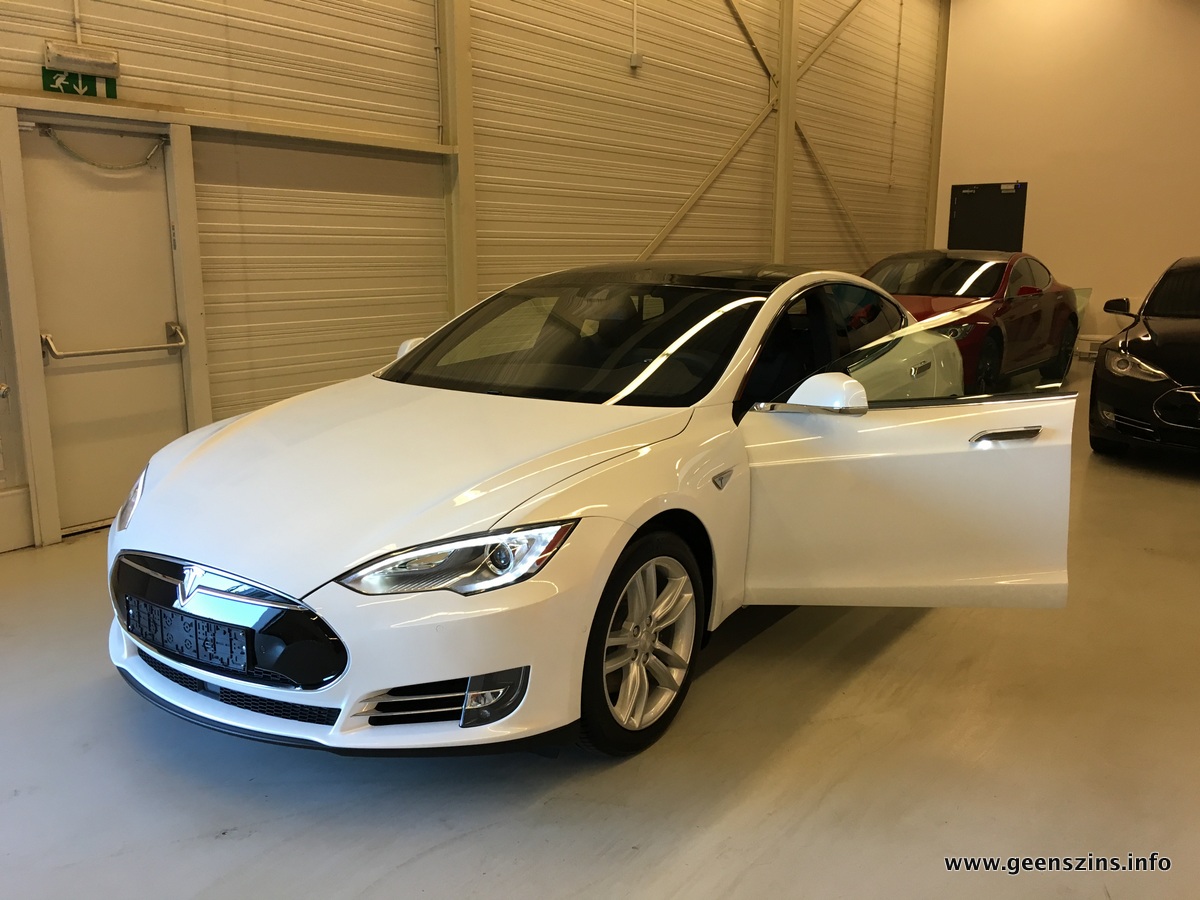
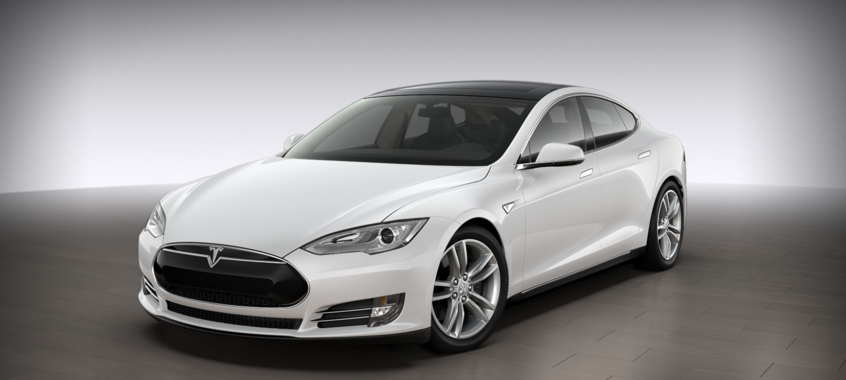 The biggest doubt was still about the color and the sunroof. For me personally, a sunroof has little added value. I'm more concerned that I closed it and that the car isn't in the rain with an open roof (thank you Tesla for making an app where I can check that remotely). I let my wife decide these two things. I did choose not to have piano lacquer: too easy to get dirty fingers. And wood finish is also not my thing, so luckily I chose the carbon finish chosen. Personally, I think I would have chosen a red car without a panoramic roof, but she and the children thought white with an open roof was the better choice. Note: in hindsight, I would not take the sunroof, as it creates extra noise while driving; you have a quieter Model S if you don't take a panoramic roof. Finally also decided to take a center console to include because such an open large bin in the middle is nothing for me. I need to be able to store some clutter easily. In retrospect: highly recommended.
Total Cost of Ownership
Important in my decision-making process was “what does this car really cost me?”. Because €110,000 is a more than decent amount, more than one bridge further than what I would actually spend on a car, even as a business owner. Because people might think that self-employed individuals just spend money to deduct it, but bottomline, you still have to earn money to pay those costs first.
They don't call me for nothing at the office mister Excel so based on what Tesla provided me, I created a nice Excel, in which I made a TCO calculation with my then current car, an Audi A6 Avant that had comparable options on board, as a reference point.
Since I am writing this post now after a lot has changed regarding registration taxes and road tax, where the Flemish government has just chosen to favor electric cars, I have recalculated my TCO calculation with current figures because I myself already fall under this new legislation. The prices of fossil fuels have fallen in price since the summer and electricity has risen. My original Total Cost of Ownership my Tesla Model S therefore looked a little different.

I think the above is sufficiently clear. In reality, figures will always deviate, but it is a realistic representation. For example, for consumption, I did not use the official consumption figures, but real figures. To be clear, these are figures that apply to a company [footnote]Also for self-employed individuals, there is no 120% deductibility, but 75% for all cars, regardless of their CO2 emissions[/footnote], so there is a role for deductible VAT [footnote]I took 50%, but nowadays this is often limited to 35%[/footnote] and taxation that certainly does not apply to a private individual.
For companies, also this warning: the 20% above 100% must be booked to a reserve account. This means that somewhere in the future, upon liquidation or distribution of that reserve, that 20% will indeed still be taxed. A fact that is never clearly stated. [footnote]Edit 3/1/16 – I was pointed to this fact by Steven Peeters after the original post[/footnote]
In this basic calculation, I choose to depreciate the cars over 4 years and have taken an average tax rate of 33%. The registration tax and road tax are therefore new figures, as are the fuel figures. It is striking that you do indeed save fuel costs, but by no means enough to justify the extra cost of an EV.
With these figures, I then worked out two scenarios: over four years and over five years.
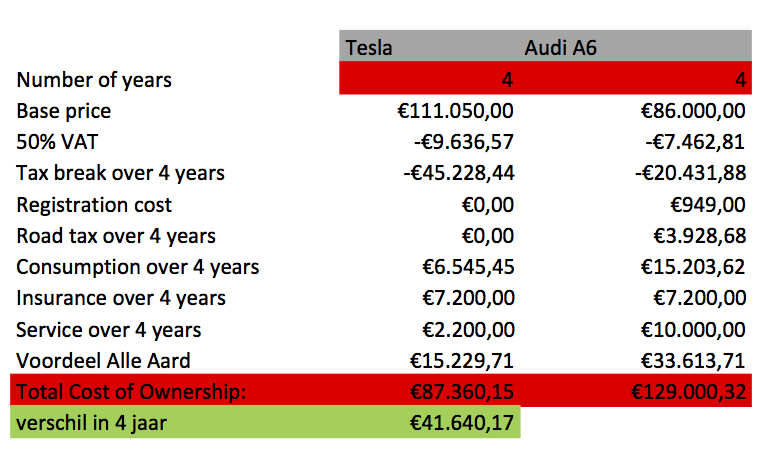
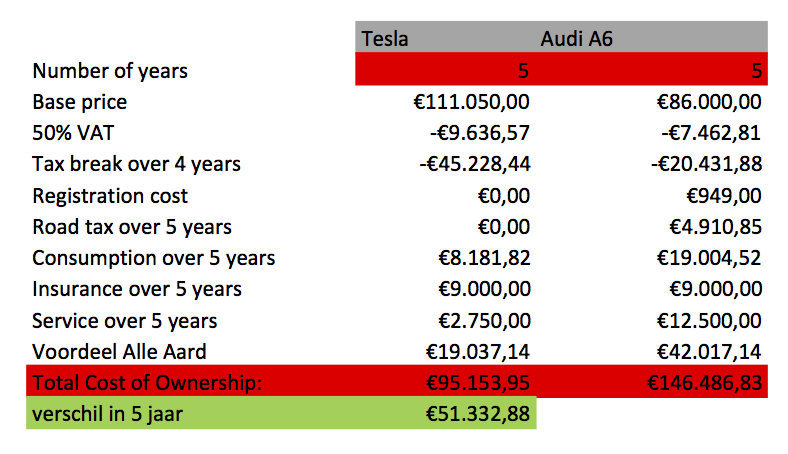
From these figures, you can see that without the fiscal measures, you cannot justify the extra cost. In this example, you should also not forget that the Audi I had had an extreme number of options, in the sense that it was much better equipped than the Tesla Model S. If you take an A6 Avant for €56,000, you are already looking at completely different figures.
An important advantage is also the Benefit in Kind (BIK) that you are charged and which increased enormously under Di Rupo II. You also save a bit on maintenance, although I think in reality I will have to go for maintenance twice a year and will therefore have to factor in an extra 2750 euros. Calculating the consumption figures over 5 years is also difficult. Will oil remain so cheap for so long, and will electricity become more expensive?
What I have not taken into account and what Tesla likes to boast about: you can charge your Tesla for free at the SuperChargers. True, but with this caveat. Always charging at SuperChargers is not healthy for your battery.[footnote]Apparently this is not generally confirmed.[/footnote] It is also not Tesla's goal. Those SuCs are intended for people who make longer trips (longer than the range of a battery charge) to have the chance to quickly recharge. A SuperCharger gives you about 80% charge in half an hour. And you have to drive around for them, because they are not yet widely available.
I expect that although I have tried to use realistic figures, I overestimate the benefit in these figures. But even if I'm 20% off, if I can save €40,000 in five years, it is financially more than worth it.
However, I would not have bought this car if we still had a left-wing government, because then I would be almost certain that the rules of the game would seriously change to my disadvantage in those five years. It is thanks to the Michel government that I dare to bet on a stable outlook and want to make this investment.
The delivery time
After the choice, also the test drive of course. Tesla's service here is truly excellent. Where in their showroom you have a somewhat disheartened impression because it is one room where one vehicle stands and so you don't have much showroom, it is so important that the sellers do make the effort to answer your questions. An appointment for a test drive is also very pleasant and easy to make. In my case, Moïs came to my house and we went over everything again and had a nice drive.
Electric Vehicles (EVs) are clearly on the rise. Looking for some background information, I looked at the statistics of the number of registered EVs in our country
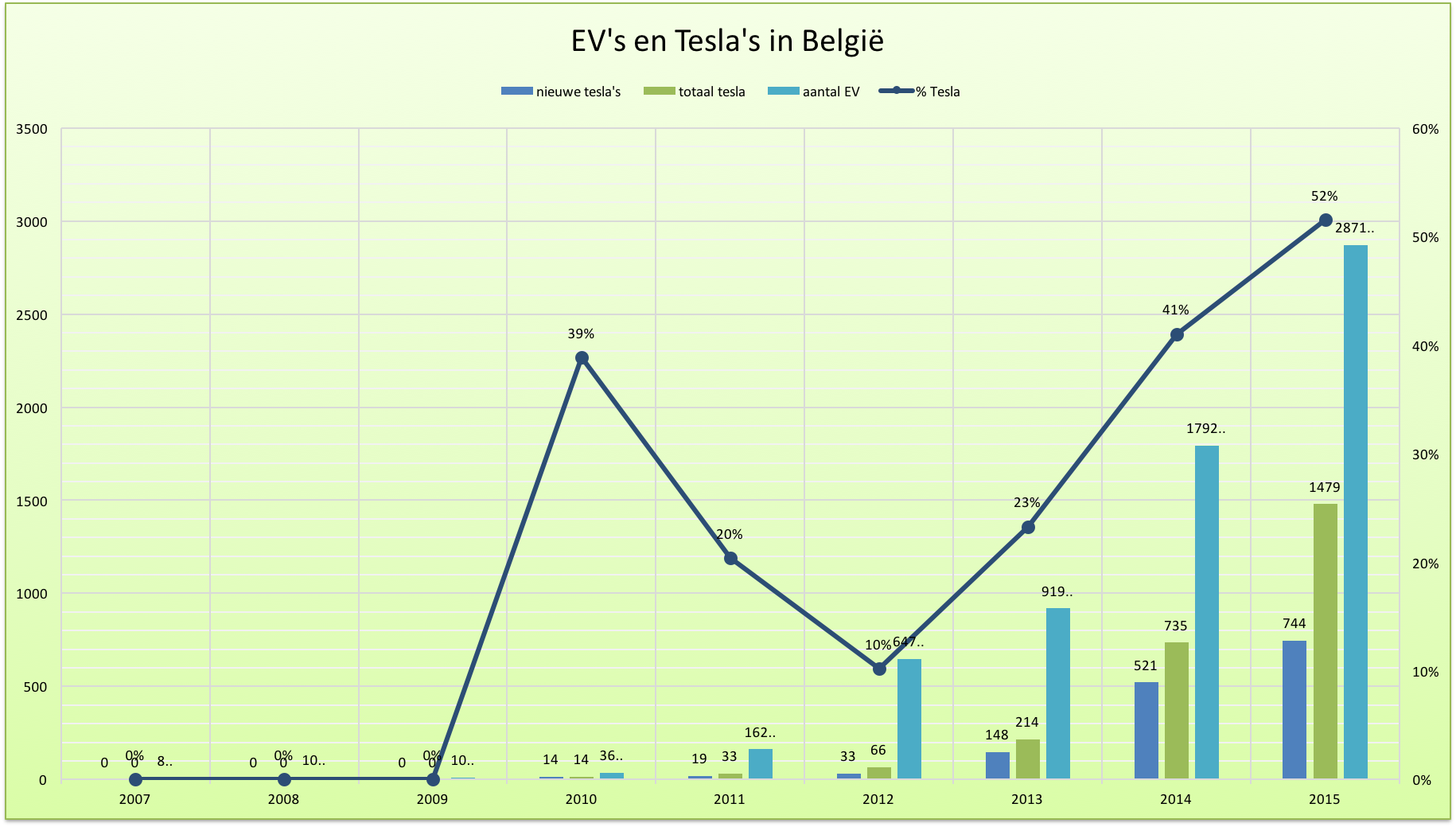
You see a clear climb in all facets. The number of EVs is clearly increasing, even the growth is accelerating. But Tesla's share is also steadily rising and still increasing. A large part of the growth of the electric car fleet can therefore be attributed to Tesla.
You also notice that in the delivery time. When I started looking around in early August and did the necessary test drives, end of October was set as the delivery time. Moïs, the Tesla sales guy, was honest enough to tell me that you could already find enough announcements on the internet that the Tesla Model S would become more expensive. In early July, it was reported that every Tesla was sold at a loss of 4000 dollars and that was approximately the amount that would be added in mid-August.
However, unlike other manufacturers, Tesla does not work with dealers, only with direct sales. In Belgium, you currently have sales points in Antwerp (Aartselaar), Brussels, Zaventem, and soon also in Ghent (Sint-Martens-Latem). Their ordering procedure is also very simple. No negotiation margin on options and discounts, just go online and click which options you want. Then you order online by paying an advance of €2000.
I still had a lot of practical questions about charging at home (see below) but I was also leaving for vacation a few days later, so to be sure of the price I immediately reserved the order. I could still cancel until August 31st. At that time, the system also nicely reported October 2015 as the delivery time.
But since I only found the final answers regarding the electrical installation on August 30th and only then confirmed my order, I had to conclude that I was probably not the only one who was aware of the impending price increase during the holidays and that a lot of orders had come in during those last two weeks, because the day after my order I received a message that I could only expect my car at the end of December 2015 or early January 2016. Bummer
How to charge?
An important question that occupied me for a long time is how I would charge. Firstly, there are fantastic possibilities with the Tesla Model S.
The Tesla Club has made a wonderful overview of all possible connections:
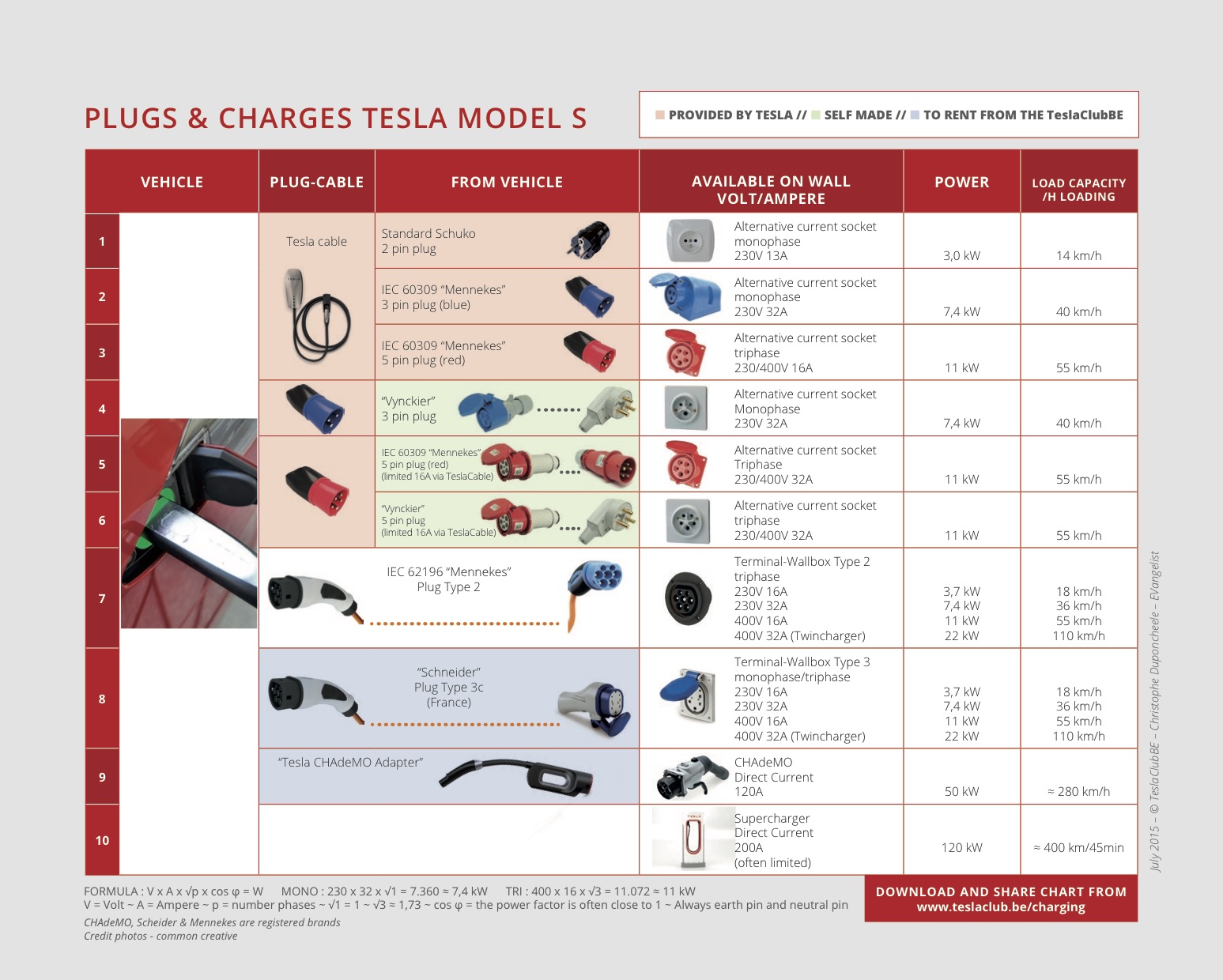
For me, it quickly became clear that due to the kilometers I cover, I would definitely need to be able to charge easily at home. Since I had a standard single-phase 230-volt connection at home, the options were limited. The fastest option I had then was either to work with a blue plug or to install a charging station on a single-phase connection. Disadvantages: maximum 40 km per hour charging and still needing 32A, so an extra cable would have to be pulled.
I was convinced that I would regularly arrive almost empty, and then a single-phase connection would mean that at least 10 hours would be needed to recharge. A long time. Too long for my liking. It would usually be possible, as the car easily stands still for 10 hours most evenings and nights, but I would miss it if I wanted to charge quickly. Plus, a cable still had to be pulled, and I was probably dealing with the Belgian neutral problem.
This problem is often unknown. Belgium actually has two ways to install an electricity network in your street. The old way of working is that two times 230 volts are placed on the pair in your street. That works perfectly, but then there is no neutral. The other way is 400 volts on one phase and a neutral. That also provides 230 volts. However, the Tesla mobile charger only works if there is a neutral (except for Norwegian plugs, because Norway is apparently also a country where it is standard not to use a neutral). In Belgiumit is, however, a gamble as to what kind of network you are connected to. In my street, both are even present.
If you don't have a neutral, you can still a isolation transformer install. You could then, for example, even convert your single-phase connection to three-phase for a charging station. The disadvantage is that an isolation transformer takes up a lot of space, is expensive, and even without a load, it still consumes power. And if you then install a charging station, you usually want sufficient power, and since most houses have a 40A connection, you would still have to contact Eandis for an upgrade of your main circuit breaker.
It quickly became clear to me: I wanted sufficient charging capacity have, still had to pull cables, spend money and put Eandis to work, so I decided to bite the bullet and have Eandis replace my connection with a three-phase connection and install a charging station. If I also installed a dual charger in the Tesla, I would have the best situation and be able to charge at 110 km per hour.
Once the decision was made, there was a lot of work to be done. Making appointments with Eandis is not really simple. However, in my case, it turned out to be a complete mess. In my electrical cabinet, I knew that four cables were connected. In my opinion, therefore, a normal three-phase connection (3 phase + 1 neutral) of which only one phase and the neutral were connected in the meter. Eandis, however, claimed that I was connected to the old network and that I received two times 230.
It got even crazier when I stated that I already had a 50A circuit breaker and the situation was that I was already receiving 50A from the cable from outside without problems, and they just had to replace the meter. My fuse box was also already equipped for three-phase operation. But no, in the 15 years that our house has been here, the standards had changed. I still had a 10 sq mm cable outside, and the current standard for 50A is 25 sq mm. So, even though everything was already connected according to me, and 50A had been coming in perfectly for years, the main cablestill had to be replaced and reconnected.
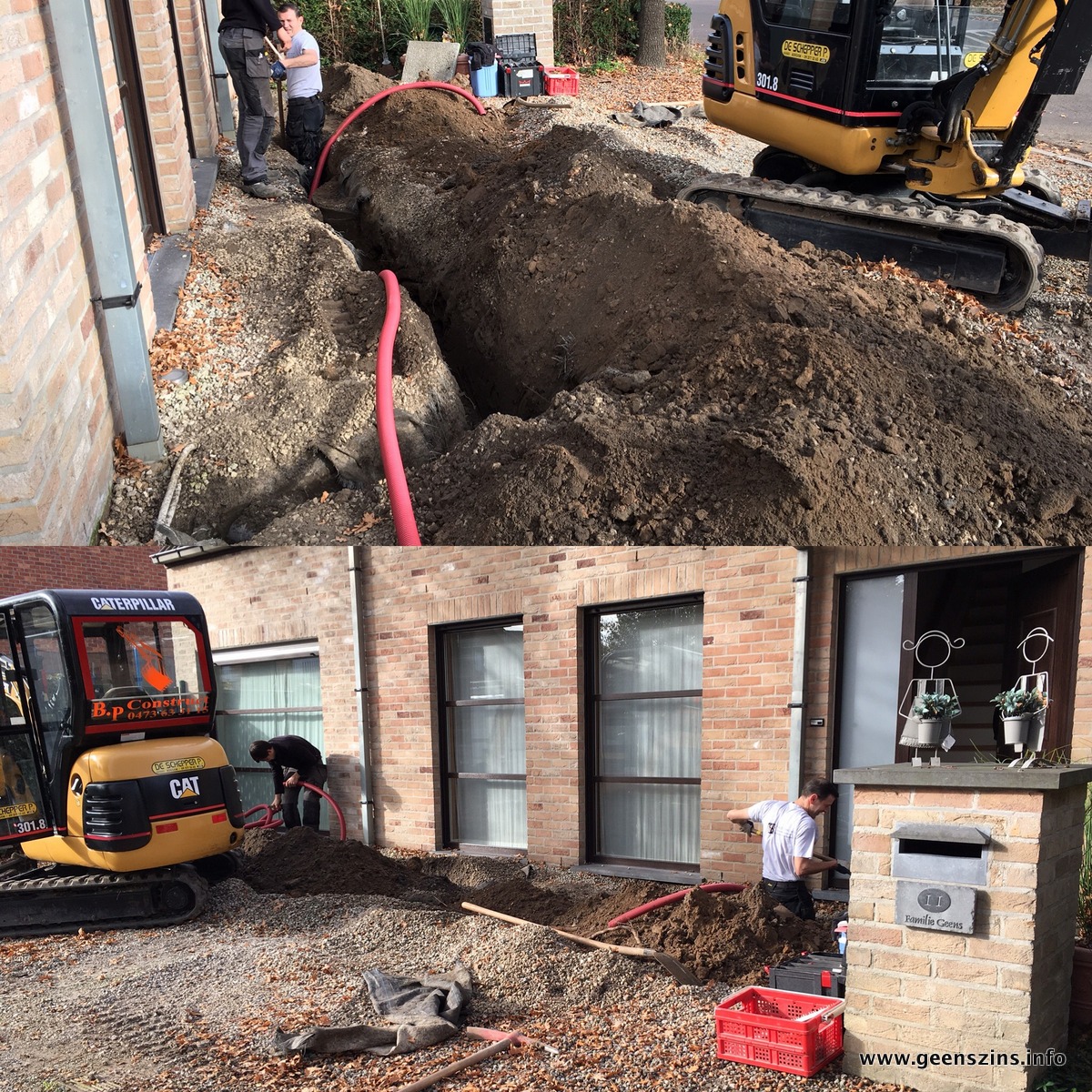 So I had my electrician do as much preparation as possible: pull the necessary cables for the charging station (fortunately we could get them before the connection bend, so no breaking or cutting had to be done inside; only the driveway had to be excavated). Making the fuse box definitively ready for three phases and having it inspected again was the next step.
Fortunately I have an excellent electrician Dirk Cherlet from Knesselare who can think along well and above all works practically. I do have another tip: make sure you don't just provide an electricity cable, but also provide a UTP cable. Someday we will have smart grids and a smart electricity meter and then it will be handy if your charging station can communicate with your meter. The standard for most charging stations for this connection is UTP. So I definitely recommend choosing a charging station with that option.
Eandis was another matter entirely. First, a pit had to be dug. Fortunately, they unexpectedly showed up at the door and a car was in the way, so they had to call. I say fortunately because they wanted to dig in completely the wrong place. Meanwhile, I know that Eandis' plans for their own networks can sometimes be meters off, and I kept a close eye when they redeveloped our street and relocated all the cables.
 Unfortunately, the excavation work is not done by Eandis itself, but by subcontractors. When I came home, there was a deep pit, nicely cordoned off, but I was also Telenet-less. Pulled a cable and said nothing. Called Eandis: “Oh sir, that's a pity. Are you sure, because the subcontractor didn't report anything? Well, we are not allowed to fix that, Telenet doesn't want anyone else touching their cables, so you have to call yourself.” Telenet: “Yes sir, no connection anymore, no TV, nothing? Then we will send someone tomorrow.” Fun evening:no TV, no internet, ... One suddenly feels cut off from the world. When someone from Telenet came the next day, they quickly saw what I had seen: a broken distribution cable. Then came the question of the year: “Sir, are you sure Eandis did this?”. Yes, Mr. Telenet, look at the sign by that pit “Eandis is working here for you”. “Yes, but Eandis didn't make a report.” Sigh... He then took photos of the pit and the sign as evidence.
The fun continued when Eandis came to make the new connection. You can guess once... Yes, I was already connected to the new network with all phases connected. A meter replacement was sufficient. But oh well, the study department had already decided that the cable also had to be replaced, so the friendly worker had to make a new connection. A lot of unnecessary digging in my opinion. And an extra €1800 cost to Eandis. But now I at least have a three-phase connection with a 50A circuit breaker and I can therefore also charge at home at 32A on 400 volts and thus install a 22 kW charging station and charging at 110 km per hour.
Choice of the charging station
In doing so, I was guided by many variables simultaneously. I knew nothing about it when I started the choice, but by reading various product specifications, I quickly came to a few features I wanted that greatly narrowed down the choice.
An important question for me as a business leader was that it's all well and good to drive electrically cheaper, but charging at home means that you pay for your own consumption, and as an entrepreneur you already pay so much and get so little from the state, that you would prefer to really charge your expenses to the company. The simplest way is, of course, to place an extra kWh meter in your fuse box and regularly read and note it down and then charge to your company.
By the way, as far as I have been able to ascertain, there is a guideline in Belgium which states that if you charge a maximum of €0.35/kWh as a private person to your company, the tax authorities do not qualify this as salary and accept it as expenses. In this way, you have some surplus on the actual cost of your kWh at home and can thus recuperate the costs you have incurred.
But to avoid all discussion and (administrative) hassle, I preferred a charging station from a brand with associated services that could offer a solution for this. Based on this criterion alone, I was most charmed by the solution from The New Motion. Their Plus subscription has the most ideal situation for me. I can perfectly set which charging card is paid by my company and which charging infrastructure is private to me so that invoices are automatically drawn up by them for the company based on my consumption and I get my costs (minus a small fee for The New Motion) refunded to my private account.
Their system also allows you to publicly available to make available (optionally for a fee or not) which I also find a plus point. I believe that as many charging station owners as possible should make their infrastructure available so that you can charge in as many places as possible, e.g., while you are visiting nearby or something.
A disadvantage of The New Motion is that they are quintessentially Dutch. In the Netherlands, they work with installers; in Belgium, you have to find them yourself. Their online system is also not really geared towards the Belgian market. For example, it is possible to ask for a maximum of 30 cents as compensation for your private electricity consumption – the Dutch fiscal maximum. Such a brand is also immediately a network. With your charging pass, you can therefore charge at all The New Motion charging stations (if the owners have set it up) and you will be billed for it via The New Motion.billed for it. If you look at their site, you'll see they have many more charging stations in the Netherlands than in Belgium. This made me doubt, but the smooth operation of their system still convinced me in favor of Belgian networks such as Blue Corner or BeChargedAdvantage that The New Motion is foreign: they have roaming agreements with, for example, Blue Corner, so I can also charge at those posts – for a fee.
 Then find an installer. The choice was quickly made there too. Joris from SolarPro/ChargingCableShop.be is himself an avid Tesla driver and truly knows his trade. He is also someone who likes to think along and knows The New Motion charging stations very well. He also helps to find the best solution for installation. Undoubtedly a good choice and truly worth a recommendation. His men deliver clean work.
Ultimately, I have provided two charging installations: at home and at the office. The office is 90 km from home and if I have to visit a distant customer, it is still convenient to have a charging point in those places in the country.  At home, I chose a version with a fixed charging cable; at the office, I did not do that on Joris's advice, to make it easier for customers to charge if they do not have a Type 2 cable. Because there isn't really a standard for that yet. Tesla chooses in Europe for type 2 Mennekes. But Audi and BMW choose CCS Combo, Japanese brands choose two connections, including Chademo for fast chargers. But in terms of ease of use, the fixed cable is still the easiest. No taking cables out of the trunk in the rain, etc... If I had to make the choice again now, I would also put a model with a fixed cable in the office.
Range Anxiety
I have been driving my Tesla Model S for two weeks now. I will describe those experiences in a separate post in a few weeks. I do want to share one thing, as I was already preoccupied with it before I bought the car: Range Anxiety. Hence my choice to do all those infrastructure works to ensure sufficient charging. The fear of not making it is present, very explicitly present.
I think that for many people this is not necessary. Not everyone travels 180 km daily for commuting like I do. You also hear a lot about what actual ranges are. I had inquired beforehand, also with experienced Tesla drivers. I was often told that 380 km on a full charge is acceptable. Well, now that I've been driving around myself for two weeks and have started some discussions about this on forums: yes, it is possible, if you adjust your driving behavior accordingly. In practice, that really means driving carefully. With such a car you will,at least in the beginning, a bit more to doLet me not beat around the bush: a range of 300 km is a realistic figure and that figure has since been confirmed by several drivers I have spoken with. People admit this more easily in private than on forums.
I have the impression that in the Tesla community, range anxiety is a taboo, although much discussed. But it's not chic to not act blasé about it. It's not politically correct to say "yes, electric driving is still an adjustment at this point". I'm now simply teaching myself to plug in the car wherever I am – at home or in the office. Better one too many charges than one too few. The only thing I pay attention to is that the battery gets enough discharge. I would not recommend this way of working for someone who only charges 20%has discharge.
I also do not recommend constantly (free) charging at Tesla SuperChargers (SuC in Teslaspeak). Firstly, it's not healthy for your battery. Secondly, however tempting it may be to have free fuel to have, this is not the purpose of the SuCs. They are there for people who need to drive further than 300 km and preferably can drive another 250 km in half an hour. If the SuCs are misused, queues arise. Not fun for people who have no alternative at that moment. So be ethical and leave the SuCs alone if you have enough other options.
To avoid range anxiety, it's good to plan. A good site is EV Trip Planner. The site is no longer actively maintained, but it is the only one with a good route planner along the SuCs. SuperCharge.info is also a good site with a lot of info about the SuCs, but not a real route planner.
Also make sure you have some good apps on your smartphone. I often use the app from The New Motion, but also Open Charge Map or ChargeMap. However, definitely don't pay €49 for SuperCharger Road Map Trip Planner – that is a real rip off and one of the few times I asked Apple for my money back because the app really doesn't do what it promises.
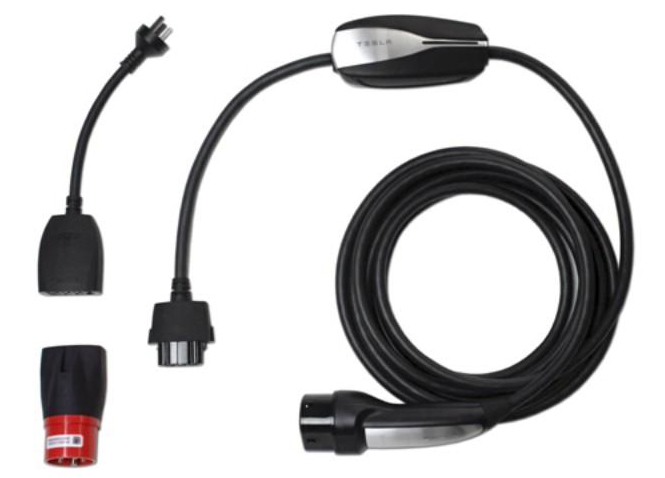 And as a final tip against range anxiety: get a series of adapters. With your Tesla, you get the mobile connector with a Schuko (regular socket) and a three-phase red plug for 16A. Be sure to also buy a type 2 Mennekes cable from Tesla right away so you can charge at most charging stations. Buy it from Tesla because the price they charge is always lower than you'll find in most online shops – if it's in stock because they fly out the door by the container at Tesla Service Centers (SeCs in teslaspeak).
I also recommend a Chademo adaptor That is the Japanese standard for fast charging and if you ever want to charge at a fast-charging station, you will often find it there. Especially if you regularly go to the Netherlands, where you can easily fast charge along the highway at the increasingly common Fastned station. Pricey for occasional charging, but just as handy. I've already made good use of it myself in those two weeks.
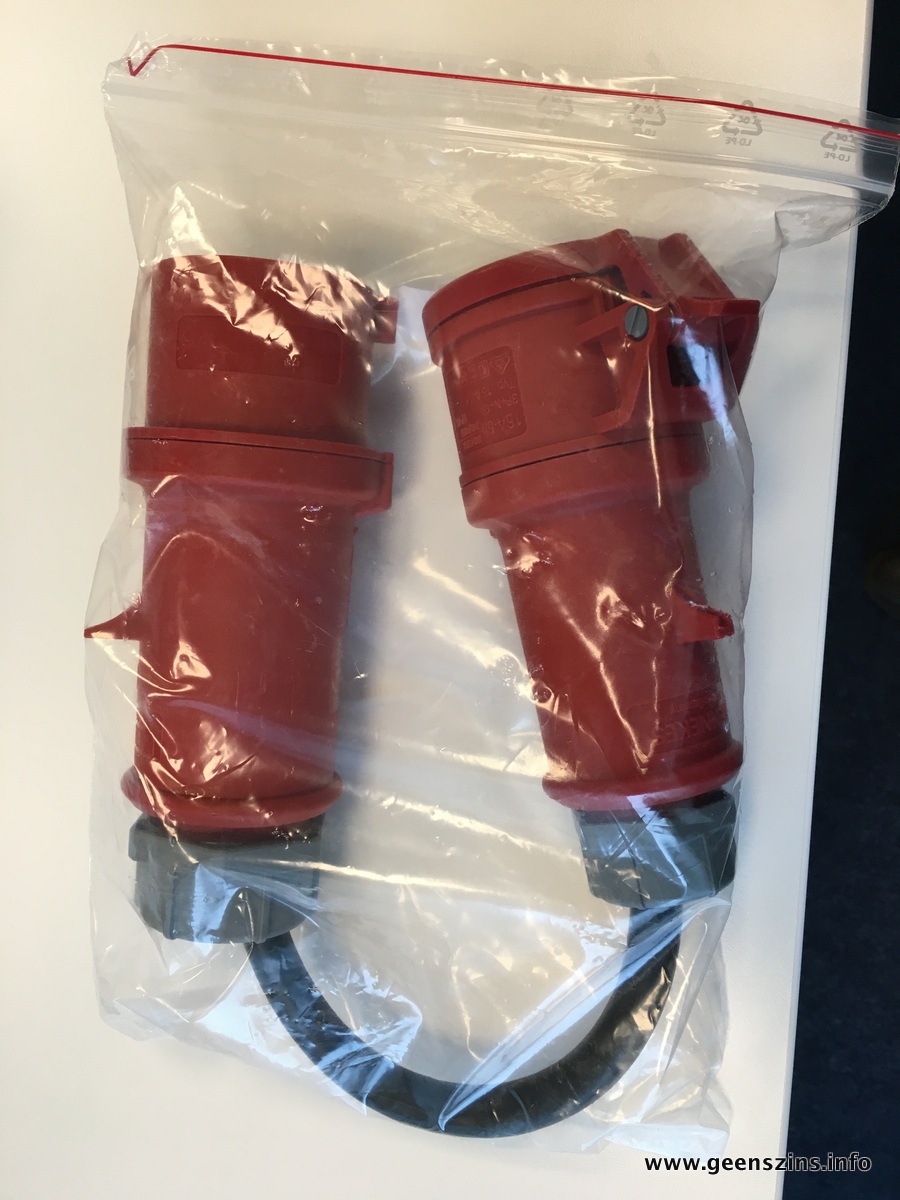 And finally: also an adapter for a red three-phase 32A to 16A plug. I've already been somewhere where there was plenty of electricity, but I couldn't plug in my supplied red plug. Available at laadkabelwinkel.nl.
And let's drive
The delivery time turned out to be even better than expected. On December 14, I could finally pick up my White Shadow (a tribute to one of the snails in Turbo) and could start gaining experience as an EV driver. There's already enough material in that for a few follow-up posts.
Discover more from GeensZins
Subscribe to have the latest posts sent to your email.


Thank you very much for an extensive post. It's nice to read how the tax benefits are arranged for you in Belgium. I can confirm almost everything I read. Only the range, I don't agree with that. Although in winter the power indeed goes fast when the heating is on and certainly also when it rains and one has a headwind, I find 300km to be very meager. Normally, I usually do better than the kilometers the car indicates as typical. With my 85 after a year and a half and almost 90,000km, that isat 90% charge a little more than 330km. I always dare to do that. In the summer, that becomes significantly more. At 100% (approx. 370km typical in my case) I certainly get 380-390. Noted: thanks to the Tesla, I have become a calm, anticipating driver. Silence and smoothness apparently have that effect on me. Range anxiety will always remain, I also had that with the petrol/diesel cars before this. You just experience it earlier and probably more often. On my commute (215km total) I have never had it; should it get tight, there isalways the SuC (Supercharger) on the way.
I wish you and your family a lot of fun with the Model S. I still enjoy it every day, wife and child with me when the three of us go out too.
I hear many different things in that range, but figures like yours are apparently only achieved by drivers who indeed learn to drive calmly. I'm not ready for that yet 🙂
Thanks for the detailed post! Nice to read. I'm curious about the follow-up posts.
Thanks for this post. I look forward to the next one.
Thank you very much for an extensive post. It's nice to read how the tax benefits are arranged for you in Belgium. I can confirm almost everything I read. Only the range, I don't agree with that. Although in winter the power indeed goes fast when the heating is on and certainly also when it rains and one has a headwind, I find 300km to be very meager. Normally, I usually do better than the kilometers the car indicates as typical. With my 85 after a year and a half and almost 90,000km, that isat 90% charge a little more than 330km. I always dare to do that. In the summer, that becomes significantly more. At 100% (approx. 370km typical in my case) I certainly get 380-390. Noted: thanks to the Tesla, I have become a calm, anticipating driver. Silence and smoothness apparently have that effect on me. Range anxiety will always remain, I also had that with the petrol/diesel cars before this. You just experience it earlier and probably more often. On my commute (215km total) I have never had it; should it get tight, there isalways the SuC (Supercharger) on the way.
I wish you and your family a lot of fun with the Model S. I still enjoy it every day, wife and child with me when the three of us go out too.
I hear many different things in that range, but figures like yours are apparently only achieved by drivers who indeed learn to drive calmly. I'm not ready for that yet 🙂
Thanks for the detailed post! Nice to read. I'm curious about the follow-up posts.
Thanks for this post. I look forward to the next one.