

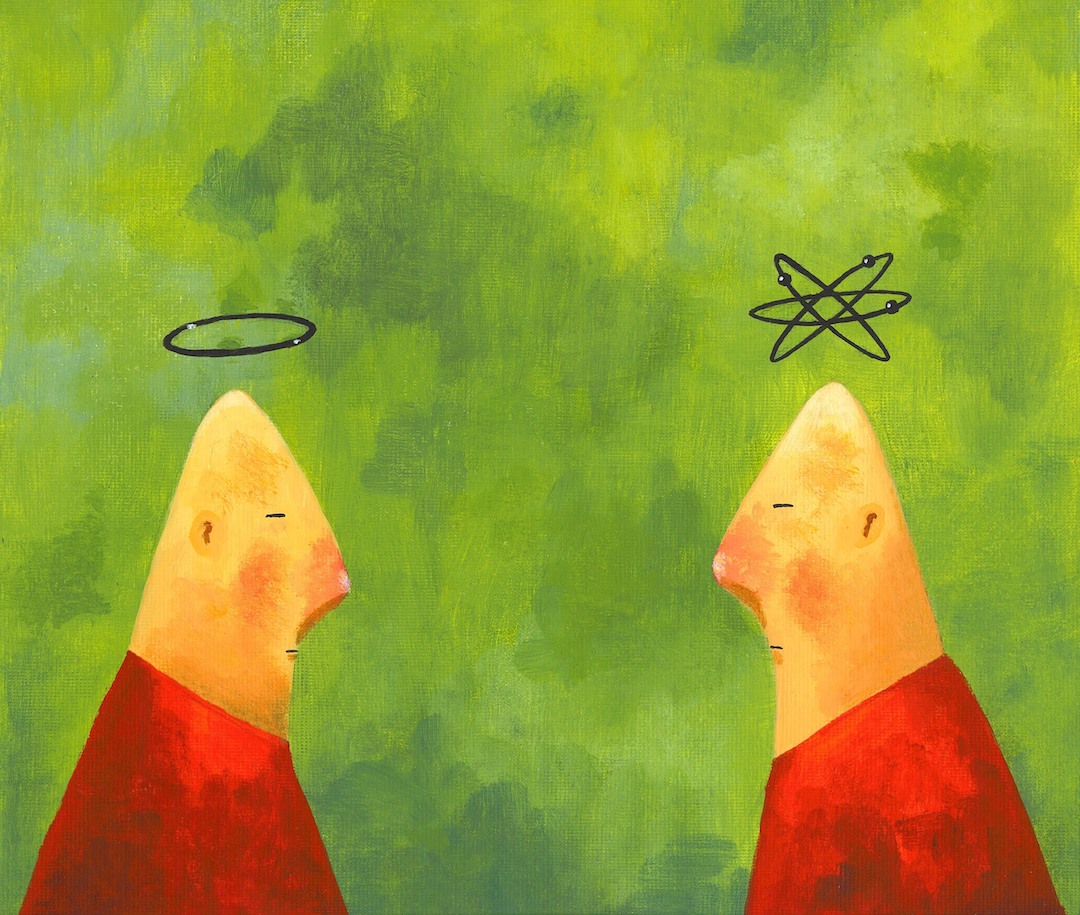
 This week I read an interesting article on Trouw.nl with the title “Is there one reality behind all branches of science?“. I was immediately attracted by this title because I have been proclaiming for years that religion and science are two views on one and the same reality. So I was immediately curious why this question was asked within the framework of science alone.
The article contains some remarkable sentences that prompted me to ponder and reflect. I would like to share a few with you.
In the book, Durston and Baggerman report on conversations they had with scientists about the great riddles with which science struggles, such as the origin and nature of the universe and the question of what consciousness actually is.
It is remarkable that science is so intensively engaged with this. I applaud it, but I regret that some scientists act as if this too is their exclusive domain. Ultimately, these are basic existential questions that for centuries were primarily answered from a religious point of view.
With this, I do not mean to say that it should therefore be an exclusive privilege of religion to find answers. On the contrary, my plea is that this is now the great common ground for both visions to join forces and, after all these centuries of fraternal rivalry, to work together and learn from each other.
And a solution to these great riddles in science is not coming, that would be too much to ask.
Is this sentence perhaps an opening to the collaboration I long for? Unfortunately not, because what science struggles with from the first quote, it has nevertheless only shone a light on the field of science. This second quote is a sigh that the authors of the book being discussed have not succeeded in finding an answer. What I find remarkable is that would also be too much to ask. Is this a question of time it is too much to ask now or a realization that the answer cannot be found solely within science?
It can be traced back to the dichotomy of body and mind, which was introduced at the beginning of the Enlightenment, almost four centuries ago, and which has been instilled in us ever since. Philosophy has meanwhile learned not to see consciousness as something separate from the body, but as a property of the whole being. But in medical and brain sciences, the dichotomy still reigns supreme, albeit with 'mind' having been replaced by 'brain'.
After reading this paragraph, as a Mormon, I was once again deeply impressed by what the prophet Joseph Smith already knew almost two hundred years ago through revelation. Mormons learn that the soul forms the whole of body and spirit and that the soul will be immortal, in other words, that the resurrection is the ultimate definitive merging of both. They are therefore inseparable.
Many people consider the soul to be what Mormons call the spirit of a human being, i.e., the immaterial part. But we therefore believe that it forms a single whole. That is also why we believe that God has a body. We are, after all, His children, and children are always of the same kind as the father. A monkey does not suddenly get a butterfly as offspring.
For the umpteenth time, I see a fact emerge that science often confirms religion. Or certainly, at least, the restored truth in The Church of Jesus Christ of Latter-day Saints. Although it is actually noted that philosophy already knows it, but the rest of science is still lagging.
Not everything can be traced back to the building blocks of matter
Or in other words: the sum of the parts is greater than the individual components combined. Darwin may have given the correct explanation of how evolution largely works, but he has not yet been able to fill in the complete picture with attention to the 'why'.
Elementary building blocks such as photons, light particles, exist as both particle and wave. Particles can be in multiple places at once. And they can remain connected over infinite distances.
Brilliant discovery recently proven by the Chinese, which has far-reaching consequences for religion. I will now leave you wanting more, but in one of the chapters I wrote in my new book “The Choice to Believe”, I will delve deeper into this. There I will show you that what science has long considered as nonsense dismissed by religion, is now actually proven by science to be perfectly workable.
But you also feel yourself slightly lift off the ground. And that continues when the next element is added: the idea that non-material phenomena, such as consciousness, thoughts, and values, determine reality just as much as the hard matter we know from physics.
Perhaps for a scientist, this is getting off the ground, but for someone who considers both science and and religion as truth, it's more like “aha, are you starting to see what I've seen for a long time?”. Again, an entire chapter of my book is about the delightful interplay between religion and science.
These are not new ideas; they have been circulating since the great Greek philosophers and took root in Christianity.
Thank you, still a sign of recognition that Christianity did not just pull it all out of thin air. Isn't it all the more remarkable then that many of these ideas have been known for centuries? Is this the moment when science might let go of some of its haughty attitude towards religion?
If that could ever be achieved, I would personally be very happy. When science and religion are no longer competitors but allies in the search for knowledge and wisdom.

 For your information: this theme is very dear to my heart. I am currently working hard on a book "The Choice to Believe" which focuses on the combination of religion and science. Believing in God is a fundamental choice that we must make in complete freedom. If you would like to be kept informed of the release of this book, please subscribe via the sidebar to stay up to date with this website.
Discover more from GeensZins
Subscribe to have the latest posts sent to your email.
