

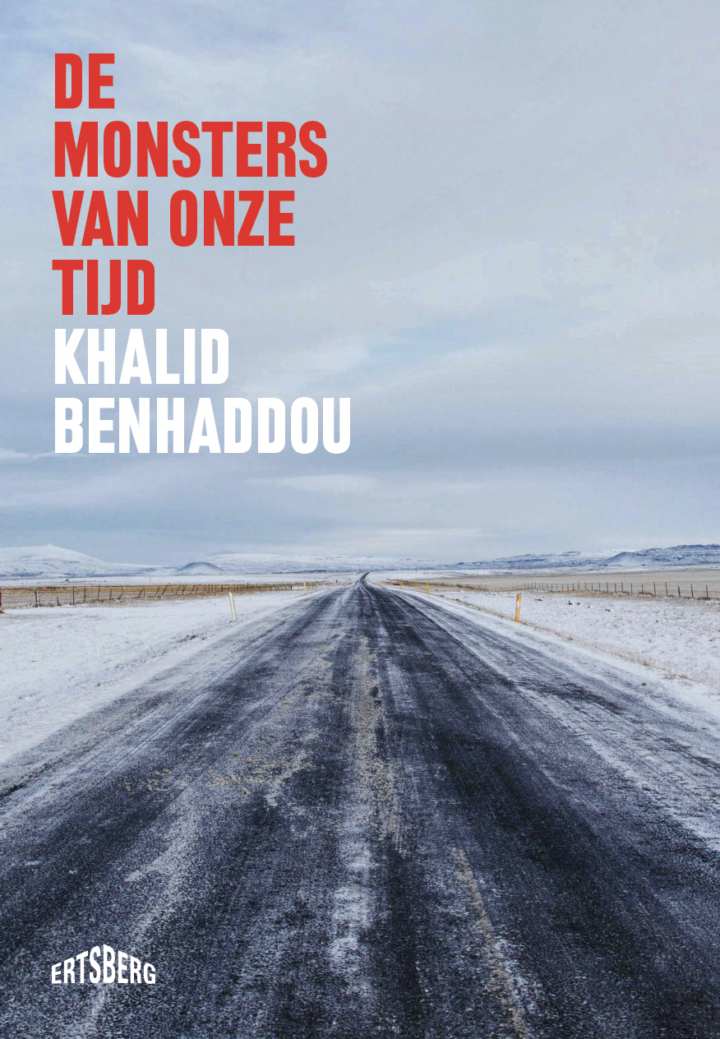
I have 'The monsters of our time' by imam and opinion maker Khalid Benhaddou just finished reading, and it lingered. Not because I disagreed with the main line, on the contrary. His premise that we are in a transitional era, between two worlds, where the grand narratives have crumbled, I fully endorse that.
Religion, ideology, the belief in progress: they have all lost their self-evidence, and in that vacuum grow the monsters he talks about. Fragmentation, atomization, the crisis of truth. He analyzes this sharply and eruditely, with an impressive arsenal of thinkers whom he juxtaposes without letting himself be swallowed up by any one of them.
That makes the book rich. It also makes you hungry sometimes, because Benhaddou often gives you the analysis without the conclusion. On the one hand this, on the other hand that. But in the places where he does show his true colors, I am grateful for that courage.
In his fifth chapter, on nostalgia, he discusses religion extensively, and frankly, he does a good job there. He weighs the positive side against the dangers, without choosing a side beforehand, and that analysis is correct. So I don't want to blame him for anything there: it is precisely the point where his on-the-one-hand-on-the-other-hand style is completely appropriate, because religion indeed carries both sides within it.
The diagnosis is correct, the remedy is flawed
Where I do part ways with him is not that analysis, but the conclusion he ultimately draws from it, further on in the book, in the epilogue. There he dares to show his true colors, and that is precisely what I appreciate, even if I don't agree with it. Benhaddou is an imam. Religion has a central place in his own life, he makes that very clear in the book, and he even writes that it is precisely from his faith that he feels the need to build bridges and enter into dialogue. For him, religion certainly belongs in public life, asa driver for individual and collective engagement. Up to that point, I fully follow him.
But then he draws a line. According to him, religion cannot be a common basis for society as a whole, because that would inevitably mean that one belief is placed above another. Hence his conclusion: the foundation of society must consist of values that are accessible to everyone, regardless of what faith or unfaith you have. Faith may drive you personally, but the binding agent of society itself must be secular.
I understand that reasoning. And I think he jumps too quickly from one option to another.
More religions as a shared foundation
Because between 'religion as an exclusive basis' and 'secular values as the only shared basis' there is a third way that he nowhere considers. That is not less religion, but more religions. Not one faith that rules, but a plurality of religions that seek each other out, question each other, and precisely through that can together bear a shared framework of values that is richer than what a secular common denominator alone can ever offer. Connection does not arise by erasing difference, but by looking it in the eye.
For me, that is not a non-committal thought, but a deep conviction. Truth and goodness are not the monopoly of one tradition. Other religions are not merely competitors of mine, but bearers of their own fragment of that same truth, each grown from their own history, language, and culture.
If that is true, then religion does not have to be limited to what it means to me personally. Then those different bearers of truth can just enter into dialogue with each other, and together form the shared foundation that Benhaddou seeks in secular values alone.
Lessons from the golden age
Now, I don't want to make Benhaddou a straw man. He is indeed right in what he fears. In chapter five, he honestly addresses the dangers of religion: dogma, the us-versus-them logic, the longing for an idealized past that never existed as we remember it. And in chapter eight, on integration, he doesn't do so from a safe distance. He even names Salafism within his own religious community as a real danger to society. I find that courageous, and it deserves appreciation, also from meas an outsider to his tradition.
But to draw the conclusion from that justified criticism that religion may at most be a personal motivator, never a shared societal foundation, that is, in my opinion, drawing the wrong conclusion from a correct observation. We may name the danger without therefore discarding the unifying force. Let us as modern believers precisely face these dangers, and thereby make religion stronger and more unifying, instead of reducing it to the individual.
And the interesting thing is: Benhaddou himself provides the evidence for my point, in that same chapter eight. He refers to the Golden Age of Islam, from the eighth to the thirteenth century, when thinkers like Averroes and Avicenna succeeded in reconciling Islamic theology with the rational philosophy of the Greeks. That was no fluke. That was a religious tradition that dared to push its own boundaries by engaging in dialogue with another worldview, and emerged stronger.
Christianity has undergone precisely the same process: centuries of struggling with and ultimately being enriched by that same Greek rationality, visible to this present day in how we as believers think about reason, free will, and morality. If both great traditions have already accomplished that, why should we assume that it cannot happen again today, and then not between those traditions mutually? Benhaddou himself shows, with his own open and self-critical attitude, that this path is viable. I do not see why religion would thenhave to result in a purely individual engine, instead of a religion that leaves its dogmas and its fundamentalism behind, but precisely because of this, can carry a shared foundation in dialogue with other traditions.
Dare to choose for encounter
What also struck me, is how the book personally strengthens my conviction about integration. If you see how a good, sincere integration enables other cultures, and thus also other religions, to contribute to building our society instead of remaining on the sidelines, then that offers hope. Not the hope that we will all believe the same things, but the hope that different believers, with an open mind towards each other, can together build something greater than what each tradition could achieve separately.
That is precisely what I am most grateful for in Benhaddou's book: it forces you to think about what connects, not out of fear of difference, but out of curiosity for it. And it is precisely why our society must abandon its convulsive fear of 'the East', of Islam, of religion in general. On that point, he is absolutely right, and that must be said.
Still, I am left with a slight regret. I suspect that Benhaddou, perhaps unconsciously, has somewhat overly tailored his conclusions to his audience: a broad, secular Flemish readership, for whom 'religion as an individual motor, secular values as a shared foundation' is the safest and most marketable message. This makes his middle position strong and sensible, but also a bit too cautious. Because from the middle, you should also be able to reach out to the extremes. Not to get stuck there, but to show that the middledoes not mean you no longer dare to choose anything.
Perhaps the most fascinating thing about reading this book is this: everyone expects a Muslim to advocate for more religion as a societal binder, and a Christian for less. With Benhaddou and me, it's more nuanced, but still the opposite of what's expected. He, an imam, deliberately keeps religion individual: a powerful personal engine for engagement, but not something that should form the shared foundation of society itself.
I, as a Christian, believe that multiple faiths, in conversation with each other, can indeed bear such a foundation together, stronger than secular values alone. Perhaps that is precisely the proof that this is not about who is most religious, but about what kind of society we want to build: a society that only allows religion as a private engine out of fear of what it could mean when shared, or a society that lets religions speak with each other and becomes stronger precisely because of that.
I would like to sit down with Benhaddou to continue that conversation. Until then, I'll leave you with this: if you think about the monsters of our time, dare to flip the question. Not: how do we keep faith out of society to preserve peace? But: how do we bring different believers together, so that their faith becomes the glue that holds our divided time together again?
Discover more from GeensZins
Subscribe to have the latest posts sent to your email.
