

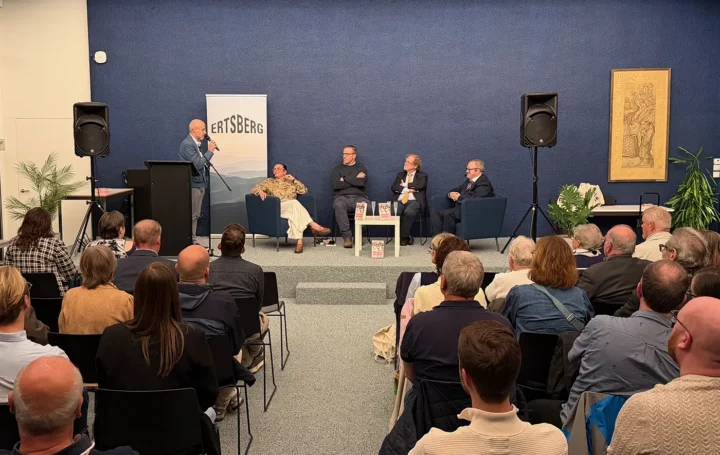
Book presentation 'Reasonably religious' Sint-Niklaas
There is a moment on such an evening when you stop being nervous. That happened to me yesterday when Jurgen Slembrouck, the coordinator of the Liberal Service at the University of Antwerp, looked me straight in the eye and said that my book contains too few arguments to convince anyone. That should have scared me. Instead, I felt something like relief. Because there, in one sentence, was exactly the misunderstanding that I am trying to clear up with 'Reasonably religious'.
But let me start at the beginning.
A room full of people who didn't have to come

On Thursday evening I presented my book in Sint-Niklaas. I had found it exciting, more than I wanted to admit. Not because I was afraid of the debate, I have not been afraid of heated discussions for a long time. Well, because on such an evening you never know who will come. A book about faith, written by a bishop of a church that in Flanders arouses distrust rather than curiosity among many people, is not an obvious blockbuster on a weekday evening.
And yet the room was full. Members of our church, of course. But also friends from the past, business people, neighbors, and a surprising number of people I just didn't know. People who didn't have to come and came anyway. That alone told me something about the hunger there apparently is for an honest conversation about faith, beyond the caricatures.
The evening started with a conversation about the book itself. Where my search started, why I started searching in the first place, and to what extent I used my mind to come to faith. The latter is the heart of the book, and I formulated it as sharply as possible yesterday: I did not start to believe in spite of my reason, but because of it. Anyone who knows me as an IT entrepreneur and nerd, as someone who prefers a spreadsheet to a sermon, understands how unlikely that sentence would have ever sounded coming out of my mouth.
Two conversation partners, two worlds

Then came the debate. On the one hand Rik Torfs, church lawyer, former rector of KU Leuven and someone who looks at Christianity with an infectious openness. On the other hand, Jurgen Slembrouck, liberal down to the fiber of his being, and completely honest about it. And in between me.
I appreciate Jurgen, let that be clear. He did what a good opponent should do: he read the book, took it seriously, and attacked it where he thought it was weak. His criticism was that 'Reasonably religious' does not provide a conclusive argument, a series of arguments that force a reasonable person to conclude that God exists. He's right. That argument is not included. I didn't write it, and I couldn't write it, because I don't believe such an argument exists.
What I answered him yesterday, and what I would like to do in more detail here: the purpose of the book is not to convince. The goal is to make you think. That seems like a subtle difference, but it is a world of difference. If you want to convince, write a treatise. If you want to make people think, they tell a story and honestly explain their own doubts, mistakes and detours. I consciously did not want to write a philosophical treatise. There are plenty of academic works on proofs of God in the library, but I have rarely had the impression that people come to believe as a result. What does touch people is another person telling the story of how he went from A to B and why.
Jurgen said at the same time that the book certainly provokes thought and contains a lot of material to think about further. That's all I ask.
Rik Torfs chose a different approach. He called the book a must-read, and he mentioned an effect that I also hope: it melts away prejudices. Towards our church, but also towards faith in general.
Let me be honest about that, because the title above this piece is not entirely true. I didn't want to convince anyone of my faith. I wanted to convince you of something else: that believing is not the same as stopping to think. Not that people become believers, but that they stop seeing believers as people who have turned off their minds. That is a much more modest ambition than a proof of God, and at the same time a much more persistent one.
The fence on the cliff
There was one image that apparently stuck, because Isabel heard it back from several people afterwards. Someone in the room asked the classic question: don't all those commandments limit your freedom? It's a question I like to be asked because it's so honest. Almost everyone who looks at a church from the outside sees rules first and foremost. Don't drink, not this, not that.
My answer is always the same. Imagine you are walking on the chalk cliffs and there is a sign warning you not to get too close to the edge. You can look at that sign and think: this takes away my freedom to stand where I want. Or you can think: this gives me the freedom to be safe, to still walk tomorrow, because the edge could crumble and then you would be a hundred and fifty meters lower. Same board, two ways of seeing.
Philosophers call this negative and positive freedom, and it is an old distinction. But you don't have to be a philosopher to feel it. My impression is that today we easily look at Christ's commandments as limitations, while you can also read them positively: as protection. I had to learn that myself. In the book I describe how I discovered that these commandments do not constrict but liberate. Perhaps the best thing about the whole evening was that I was able to explain that yesterday and that people went home with it.
Who is this book actually for?
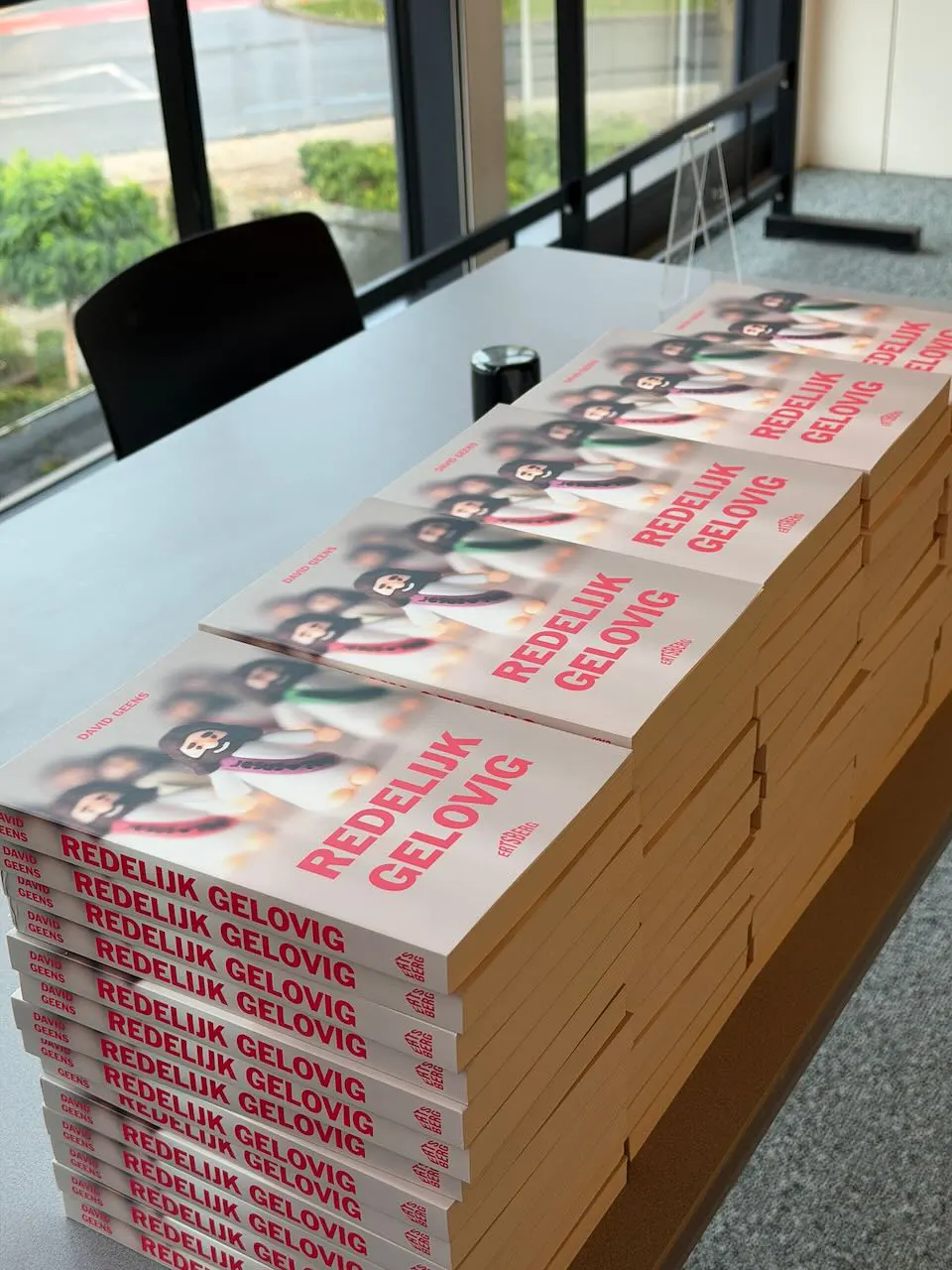
I also asked Isabel that question afterwards. I had written the book in my head for people outside the church: for those who doubt, for those who search, for those who always thought that faith and reason were mutually exclusive. But the reactions of members of our own church surprise me. Apparently they are also curious about how a bishop thinks, what he struggles with and how he views the church itself.
And I do the latter quite openly. I like to make the distinction between learning and custom. Our church has a living prophet and is therefore also a church on the move. At the same time, she tries to hold on to something in a world that is changing rapidly. This tension interests me enormously, but as a bishop I can ultimately summarize my task in one question: how do I bring people closer to Christ? Everything else is subordinate to that.
The book is therefore emphatically my personal view. It is not the truth, and it is not a position of the church. Anyone who reads something different into that is reading incorrectly.
What remains
What I remember most are not the compliments about the readability, although they are valid. “I'm not a reader, but I finished this in a few evenings,” is a sentence I've heard more than once. What remains are the people who said afterwards that they had been thinking about certain things for so long, and that they are now looking at them this way for the first time. Someone said that that one evening alone had enriched his thinking. None of them said he believes now. That's not necessary. They said they started looking differently, and that's exactly the only thing I wanted to convince anyone of.
There will be a sequel. Several people asked if we could repeat the debate elsewhere, so that they could also invite their friends, and the participants were immediately willing. I also like to speak somewhere alone, because I notice that the conversation goes beyond my book. It's about the question of whether there is something more than us, and about how you can ask that question without hanging up your mind.
I would like to have that conversation for a while.
Discover more from GeensZins
Subscribe to get the latest posts sent to your email.
