

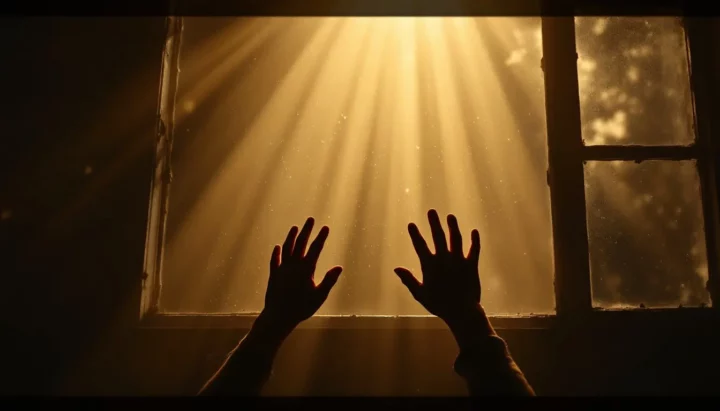
Yesterday a good friend asked me how I was doing. Not the polite question you bounce back with 'good, and you?', but a real question. And I was glad he asked it, because things are currently a bit more difficult at home. My oldest son Laurens has autism, and at the moment I find it hard to understand his behavior. There are moments when the emotional tension becomes too much for him, when he exhibits extremely rigid behavior, and when I no longer know what to do. Any guidance then seems impossible, and at such a moment I feeljust a failing father.
My heart lightened when I could tell it. A friend with a listening ear is a true blessing at such a moment. But he also asked a good question, a question I often get. Do you sometimes have those days when you think: what have I done to deserve this?
Such days are part of it
I am called to be a bishop. I have a calling in the Church of Jesus Christ of Latter-day Saints. And yet, or perhaps precisely because of it, there are days when I think: does this really have to be? Can it be a bit less? There are moments when it is too difficult for me, when in prayer, sometimes even in a cry, I say: please, I can't do it anymore. What have I done to deserve this? Does this have to be now?
I think we all have those days, and that's not abnormal. In fact, I think it's precisely part of what the plan of salvation teaches us. We are here to learn. We are here to grow. And that cannot happen without the necessary setbacks.
It's not that our Heavenly Father scatters everything in our path with the thought: let's make it difficult. No, I don't believe that. His goal is for us to reach the end, and He is there to help us. But He will not simply remove the setbacks, because He knows we need them to grow.
In 1 Corinthians 10:13 we read that God will not allow us to be tempted beyond what we can bear, but with the temptation he will also provide the way of escape, so that we can endure it. I find that one of the most comforting promises in scripture. Not because it removes the burden, but because it says there is always a way to bear it.
But it doesn't always feel that way
I want to be honest about this. Reading this promise is one thing. Feeling it at the moment itself is something completely different. There are moments when adversity doesn't make you grow, but just strikes you down hard and hurts. That you don't feel there's 'an opportunity for growth' in it, but only darkness. I think we should never underestimate that. Our faith is tested precisely at such moments, not when everything is going smoothly.
For me, that doubt isn't so much about whether I still believe. That foundation stands. It's more about the question of why this is necessary. I try my best as a father. I look for solutions, and sometimes I don't find them. I feel like I'm failing. And then that question comes up again, the same one I asked at the beginning: what did I do to deserve this? Why do I have to go through exactly this, even though I'm doing my utmost?
That is not a question I can easily dismiss with 'it's for your own growth'. At that moment, that answer often feels too small for the pain it needs to explain. What keeps me going then are not great insights, but fixed habits. The habit of praying. To pour out my heart, even if I don't immediately know what to say, and certainly not why. That ritual always brings me back on track a little bit. It doesn't take away the question. But it gives me just enough strength to persevere, even without mealready knowing the answer.
And I am convinced that precisely that can make the difference. Not between having or not having adversity, that will happen anyway. But between succumbing to it or just keeping it manageable.
What I now pray for Laurens
I do that now with Laurens too. In the moment itself, when he gets stuck and I get stuck with him, I often don't know what to say. It feels desperate, and I feel like a failure. But afterwards, in prayer, it's much more in the sense of: Heavenly Father, give me the insights to understand him better. Give me the insights to deal with it better. Because I need that to become a better person.
The plan of salvation teaches us that growth serves a purpose. That we will one day return to our Heavenly Father, and that there we will take on leadership in the heavenly kingdom. Or as we say: we are blessed to become kings and priests, not just to be followers.
But whoever wants to fulfill those tasks at a heavenly level must have learned a lot and be able to deal with many things. That's why I can deal better with adversity, even though it doesn't take away that it sometimes just seems too difficult. That is the strength I find in my faith. In knowing how Heavenly Father is there to help.
A God of inclusion
I know that Heavenly Father is a God of inclusion, not exclusion. He will do everything possible to keep us with Him.
If you know that He is not lurking to catch you making mistakes, but is around the corner to catch you, that gives enormous strength. A supernatural strength.
When people ask me how faith can still help in contemporary society, this is the answer for me. We don't have to look any further than this.
A small miracle this week
And this week I felt that again, in a way that surprised even me. I was stuck. The tension around Laurens had blocked me, and I saw no way out. I was essentially treading water. And then it was precisely that conversation with my good friend that brought the solution. Not because he solved the problem, but because I could vent my heart.
And what struck me even more: at that very moment, while I myself was feeling down, I could serve. Being active as a bishop, helping someone else. And because of that, my own misery was temporarily put aside. That removal of tension, by serving and by that conversation, gave me the strength to look at it differently again. To once again look for ways to deal with Laurens.
I think the solution is not always a sudden intervention, something that just drops out of the blue. Very often it lies in small things. Heavenly Father knows very well what we need. But we must be open to it. Even, or precisely, when we are in a slump, we must dare to recognize that things are happening in our lives that truly help us. And when we see that, we must seize them with both hands.
I hope that everyone who is having a difficult time can somehow feel God's love. Sometimes it comes in the form of a friend who asks: how are you doing? And I hope that I myself can often be that person, the angel that God sends in answer to the prayers of someone who also thinks that day: does this have to be now?
Discover more from GeensZins
Subscribe to have the latest posts sent to your email.

Dear David, what a wonderful piece of recognition you write about. My son is addicted, so there are challenges for me there too.
Also questions, a plan of salvation? Never heard of it, nor that we will become king or priest, rather not actually.
I had received the beautiful figurines of Jesus and these pieces are a bonus! Thanks!
Annemieke
Dear Annemieke,
Thanks for your message, that also helps me to know that others find some support in what I write.
Thank you for your questions. They are very good questions and I will try to answer them concisely here, but actually they deserve a much more extensive explanation than is possible here.
The plan of salvation is the comprehensive answer to the big questions of life: where do we come from, what are we doing here, and where are we going? As members of The Church of Jesus Christ of Latter-day Saints, we have been revealed that we are truly children of heavenly parents, and that our Heavenly Father at some point proposed a plan to help us grow and learn further. The ultimate goal is that we can return to Him, but enriched by everything we have learned. To allow us to learn independently in completefreedom to learn independently, He created the earth for us and granted us life as humans.
The plan of salvation therefore means that we know why we are here: to learn and grow, with the intention of returning afterwards to our heavenly parents and continuing to grow there as well. As some briefly summarize it: we continue to grow to ultimately become like God ourselves. Whether we will ever achieve a divine status with that has not yet been fully revealed, but as children of God, we do carry the potential within us to continue to grow in that way.
This naturally gives a special meaning to why we are here and to the importance of the gospel of Christ. It means that our heavenly parents love us and have not given commandments to make us stumble or exclude us. On the contrary, everything He does is aimed at making it possible for all of us to return to Him. The suffering and death of Christ also serve this purpose: because we commit sin, Christ, who Himself was without sin, paid the ransom for us, thereby fully satisfyingthe justice of the Heavenly Father, and yet we can receive forgiveness.
Everything within the gospel therefore has only one goal: that we can become immortal and continue to grow. The reference to king and priest relates to this: we believe that latter-day saints, when they do their best, get the chance to take an exalted place in the afterlife, designated as being a king and priest in the kingdom of God.
All of this naturally encompasses much more nuance than I can convey in this short summary. But if you want to know more, feel free to let me know.
You never fail until you stop trying – Albert Einstein
... You are High Priest, not my father, not me and not my children either
... that is the difference ...
I really can't imagine how that could make a difference to Heavenly Father. He loves all His children. Their priesthood doesn't matter in that.