

In short
More and more people feel empty or lonely, despite a life full of social media and social hustle. This is no coincidence: when the line between man and God weakens, the line to others suddenly has to bear all the weight alone, and under that, it bends. An ancient insight from Genesis and a simple triangle shows why, and what small gesture can restore that balance this week.
Almost every week I receive a message from someone I have never met. Via Instagram, via the contact page of this blog, sometimes via an email that reached me through various channels. People who know that I bear an ecclesiastical responsibility, and who then entrust me with something they dare to tell few people in their environment. Why do I feel so empty? Or the twin sister of that question: why do I feel so lonely?
It's not always the same people. Students, young parents, retirees, people with busy social lives and people who haven't spoken to anyone in months other than the cashier. What they have in common is that empty feeling itself, and the surprise that it's there. Because they have everything, don't they? A phone full of contacts, an agenda full of activities, a feed full of photos of people seemingly sharing their entire lives. And yet, somewhere in the midst of that hustle, it feels like someone has turned out the light.
Emptiness doesn't always have a single cause. Sometimes grief, exhaustion, depression, trauma, medication or physical problems play a role. These then deserve real care and sometimes professional help. A spiritual answer should never be a reason to postpone medical or psychological help. But strikingly often, I also hear the same desire in these stories: the desire to be truly connected again, with oneself, with another, and perhaps also with God.
Emptiness in a hyperconnected world
I don't think it's a coincidence that so many people are struggling with this question today. We come from a period in which connection was often organized more naturally. You lived in your village, you knew your neighbors, associations brought people together, and faith was usually closely intertwined with that.
That earlier world was certainly not better or safer for everyone. Villages could be suffocating. Communities could exclude people who deviated from what was considered normal. Religious communities could also cause social pressure, fear, or shame. But that world did offer structures for encounter that have become much less obvious today.
What came in its place is a hyperconnected world in which, paradoxically, we are becoming increasingly lonely. Older people sit all alone in an apartment with a phone full of WhatsApp groups. Young people have hundreds of followers and don't dare to express their own opinion aloud at the table. People talk to each other all day, but sometimes have no one to whom they can truly tell how they are doing.
That is not just a matter of individual character. It is also a symptom of something we have all let slip away. We have more means of communication than ever, but communication is not yet connection. We are constantly visible, but therefore do not truly feel seen.
The triangle of yourself, the other, and God
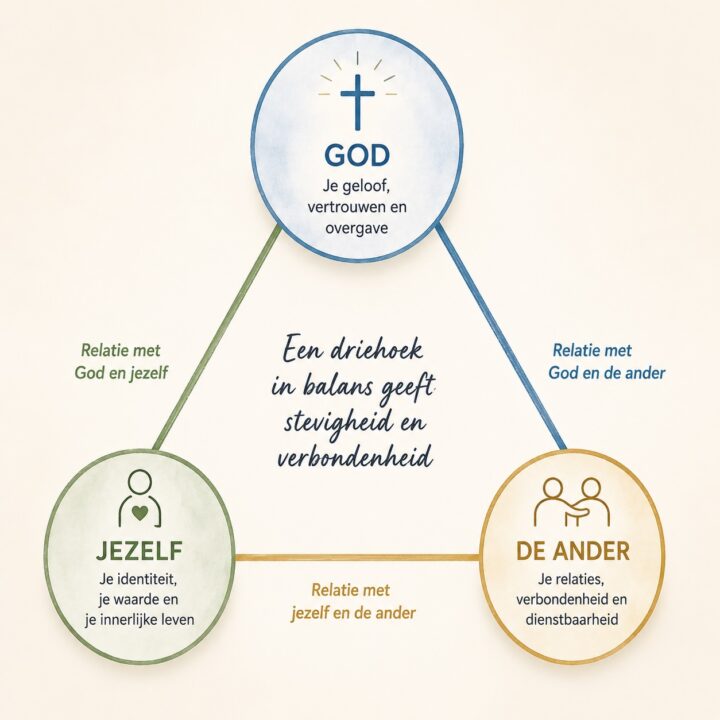
I often think about this in terms of a triangle. Not because I particularly like diagrams, but because it helps me understand where things can go wrong. In that triangle, there is a corner that is yourself, a corner that is the other, and a corner that is God. Three lines connect them. As long as these lines are approximately equally strong, the shape remains upright.
There is the relationship with yourself. Can you live with yourself when it becomes quiet? Do you know who you are when you're not achieving anything for a while? Can you look kindly at your own shortcomings, desires, and limits?
There is the relationship with others. Are there people with whom you don't have to prove anything? People who not only know what you do, but also who you are? And do you dare to truly be present in someone else's life?
And then there is the relationship with God. Not just as a conviction or an idea, but as the possibility that your life is sustained by a love that is not dependent on your success, your popularity, or the judgment of other people.
The problem of our time is not necessarily that this entire triangle has disappeared. The problem is that some lines have become increasingly thin. In our secularized society, especially the line between humanity and God has become almost invisible for many. As a result, more and more weight falls on the two remaining lines.
The self and the other must then together carry something they were never meant for. We expect ourselves to give full meaning to our lives, and at the same time, we hope that other people will fill the void we experience within ourselves. But no person can fully carry themselves. And no other person can be everything to us.
That is, by the way, not a new insight. It is already stated at the very beginning of the Bible, even before there is any mention of sin or a broken world. 'It is not good for man to be alone,' it says in Genesis 2:18. Not as punishment, not as a consequence of something wrong, but as a statement about what a human being fundamentally is.
Loneliness is therefore not primarily a personal failure. It is a break with something that is embedded in the blueprint of our existence. We are not made to rely solely on ourselves. We are relational beings. We need others, and according to the gospel, we also need God.
Loving God and loving others
In the gospel, these two lines are never presented separately. When Christ was asked what the most important commandment was, he did not answer with one commandment, but with two that are bound together: 'Love God with all your heart' and 'love your neighbor as yourself,' as it sounds in Matthew 22:37-39.
Whoever dissects that will see the lines of the triangle exactly. God, the other, and yourself are not separate from each other.
The apostle John draws an even sharper conclusion when he writes that whoever claims to love God but hates his brother is fooling himself. So you cannot say: I'll sort it out with God, and meanwhile ignore the other.
But the opposite is also true for me. Human connection is precious and necessary, but it becomes vulnerable when it has to bear all our need for identity, comfort, and meaning.
Can human connection alone suffice?
I know what some readers of this blog are thinking now. Does that third corner absolutely have to be there? Aren't a good sports club, a close group of friends, or a nice neighborhood equally capable of alleviating loneliness?
The answer is, in part, yes.
Those kinds of connections really help. People need concrete communities. A neighbor who rings the doorbell, a friend who listens, an association where you are expected, a table where there is a place for you. You should never underestimate their value.
My experience — and I consciously say experience and not proof — is only that human relationships struggle as soon as they have to bear all our need for meaning. No partner, friend, child, or community can be everything to us at all times.
You see that in relationships that crumble under the pressure of becoming each other's sole source of happiness. You see it in friendships that break because expectations are constantly raised. You see it in parents who derive their entire identity from their children, and in children who have to fulfill dreams that are not truly theirs.
For me, God is therefore not a competitor of human connection, but the foundation on which it can rest. He does not take the place of the other. He precisely frees the other from the impossible task of filling my entire emptiness.
When I believe that my deepest worth does not depend on the approval of another, I can love that other more freely. Then I don't have to constantly ask them to affirm me, make me happy, or give my life meaning. The third corner does not make the other two redundant. It actually helps to keep them bearable.
Faith is not a vaccine
Still, I don't want to be dishonest about this. Even within my own faith community, people struggle with that same empty feeling, with loneliness, burnout, and depression.
Faith is not a vaccine.
I know the temptation to say: come to us, and all your problems will be solved. It's not that simple. A church can be a place of deep connection, but even there people can feel unseen. You can sit among others every Sunday and still feel that no one truly knows what's going on inside you.
Prayer also doesn't automatically make sadness disappear. Scripture texts don't replace therapy. A spiritual conversation doesn't make medical care superfluous. Anyone who experiences emptiness due to depression, trauma, grief, exhaustion, or illness sometimes needs more than good intentions and an invitation to believe harder.
What I do dare to say is that the direction the gospel points to is correct. Not as a quick fix, but as a path that teaches you step by step to live again in relationship. With God, with other people, and also with yourself.
A neglected line in a triangle does not recover in one evening. Trust grows slowly. Connection requires repetition. Sometimes recovery doesn't start with a great spiritual experience, but with the realization that you no longer have to carry everything alone.
Which line has become the thinnest for you?
So if you feel empty or lonely this week, I want to ask you not to immediately grab another task, another achievement, or another evening full of appointments to drown out the feeling.
Rather, take a look at your own triangle. Which line has become the thinnest for you?
Perhaps you have lost contact with yourself. You still know what everyone expects of you, but no longer what lives within you.
Perhaps the line to others is worn out. You talk to many people, but you don't dare to tell anyone that you're not doing well.
Perhaps the line to God has become thin. Not because you consciously said goodbye, but because it has been a long time since you were quiet enough to expect something from Him.
Then dare to make one small gesture to make that line a bit thicker again.
Send a message to someone you haven't spoken to in too long. Say a prayer, even if it feels awkward. Take a walk without headphones and without a phone in your hand. Be present for someone else for half an hour, without wanting anything in return for yourself.
But perhaps you shouldn't give any more. Maybe you've been taking care of everyone for too long. Then the bravest small gesture might be to tell someone: ‘I'm not doing well. I don't know how to carry this alone.’
Ask a friend to visit. Make an appointment with your doctor. Find a therapist. Step into a faith community, not because you immediately have to contribute something, but because you too may be received.
You don't have to become strong enough first to earn connection.
I read all comments on this blog, even if I can't always reply immediately. And if that question, why do I feel so empty, also creeps up on you: know that you are not the first to ask me, and certainly not the last.
Discover more from GeensZins
Subscribe to have the latest posts sent to your email.
