

Last time I left you with an eighteen-year-old nerd who had just arrived in Italy. A boy who read encyclopedias from cover to cover, drew chicken coops without chickens, and had categorized God among the dogmas. I ended with a comparison I didn't understand myself back then: that this journey would turn out to be my Road to Damascus, just like with the apostle Paul who was thrown from his horse by an apparition that turned his whole life upside down.
I didn't know I would experience that literally. In no way could I have prepared myself for it.
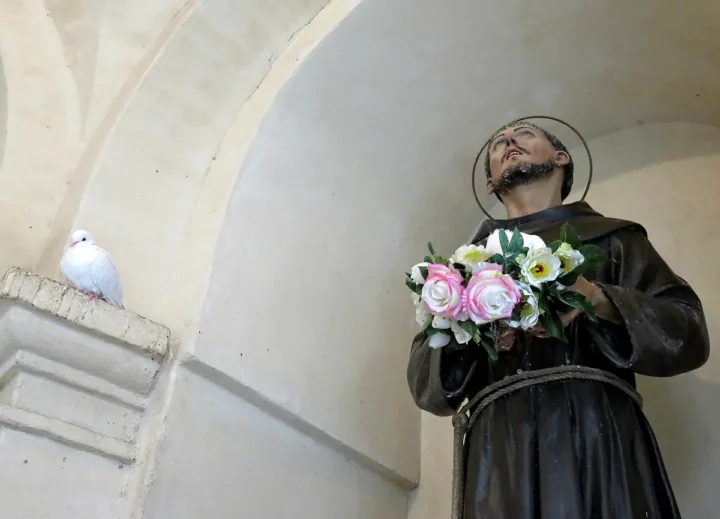
There is a statue of Saint Francis in the Santa Maria degli Angeli that I will never forget.
Not because I was prepared for it. Not because I was looking for something. I was, as you now know, an eighteen-year-old with a mask of self-confidence and an analytical mind that wanted to dissect everything — including architecture. Assisi was a point on the route, not a destination in itself.
Francis is depicted with his hands open, like a chalice catching something. As I stood there, two living turtledoves sat in those hands. No idea how those creatures remained so calm with all the tourists and their noisy cameras. My analytical mind immediately searched for an explanation. A trick? A ruse? Trained doves?
As I studied that, something happened for which I had no category.
Not a voice. Something worse.
I heard nothing. Let me be clear: there was no voice in the church. Nobody spoke to me. There was no light descending and no angel spreading its wings.
But I remember a voice, which I didn't hear, but felt.
That is the strangest sentence I have ever written, and it took me years to dare to write it. My mind said there was nothing. My memory registered something. And those two have been in conflict ever since.
The best I can do is describe what was going through my mind. It was a feeling that something had been said. An impression of words. It felt like the moment right after something remarkable has happened and you think ‘wait, what was that?’ — but without the actual event that preceded it. It was the echo without the clap.
What I remember having ‘heard’: David, what are you actually doing with your life? Don't waste your chances. I need you.
I walked away. Almost tripped over my own feet.
The second time
I walked in the wrong direction. In the confusion that followed, I allowed myself to think it was imagination. Just a strange moment, like you sometimes have. I was tired, maybe. Or the architecture had done something to me. There certainly were scientific explanations for these kinds of experiences — and the nerd in me still loved science more than mystery.
I set out to return past the statue, as if I wanted to prove it. See, nothing is wrong. A statue is a statue. A dove is a dove.
It happened again.
This time with one extra sentence: You have to make a choice.
I left there without further heroism. Completely overwhelmed, in silence, while the rest of the group walked around elsewhere and no one had noticed that I had just fallen from my pedestal — figuratively, though it also felt a bit literally so.
What I thought of it that evening
That evening I would have told you that I had heard a voice. An hour later I would have said it was imagination. An hour after that I wasn't sure anymore.
That pattern kept repeating, not only that evening but throughout the years that followed. I had one memory but two stories about that memory, and they constantly contradicted each other.
As the boy who in the previous piece still thought every question had only one correct answer, I knew what to do with that situation: hypothesis, proof, conclusion. But how do you prove something that has played out in your own consciousness? How do you distinguish a real memory from an invented one?
I cannot give you watertight proof here. I never can. What I can give you is what I learned over the years about the difference between a fabrication and a real experience.
Fabrications fade. They become vague, they flake off, they adapt to the story you tell about them. Real memories have a tenacity that you cannot reason away. They are stuck in a detail — the position of his hands, the pigeons, the way I stumbled — and that detail does not disappear, even if the story around it has changed twenty times.
That's still in there, thirty years later.
What I now think of it
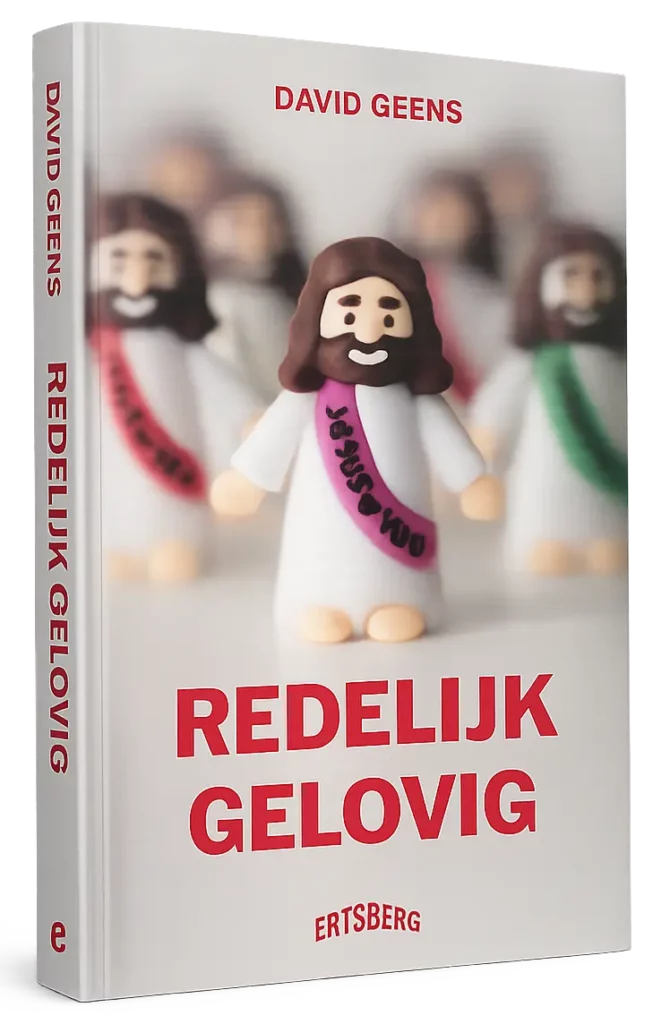
I joined The Church of Jesus Christ of Latter-day Saints. That is a long story with many detours — the studies, the books, the conversations, the doubts, the decisions. I will tell that story later and in more detail in my book ‘Reasonably Faithful’, which will be released on September 15. In it, I explain how that one memory eventually grew into a conviction, and what steps were involved.
But when people ask me when it actually started, I always say the same thing: in a church in Assisi, in front of a statue with pigeons, on a day when I wasn't looking.
To this day, I'm not a hundred percent sure what exactly happened. I don't want to claim that either. What I do know: it changed my life. Not that day — that day I was mostly confused and a little scared. But it set something in motion that couldn't be stopped. The nerd who wanted nothing to do with God started asking questions anyway. And asking questions, that was the one thing he had always been good at.
Discover more from GeensZins
Subscribe to have the latest posts sent to your email.
