

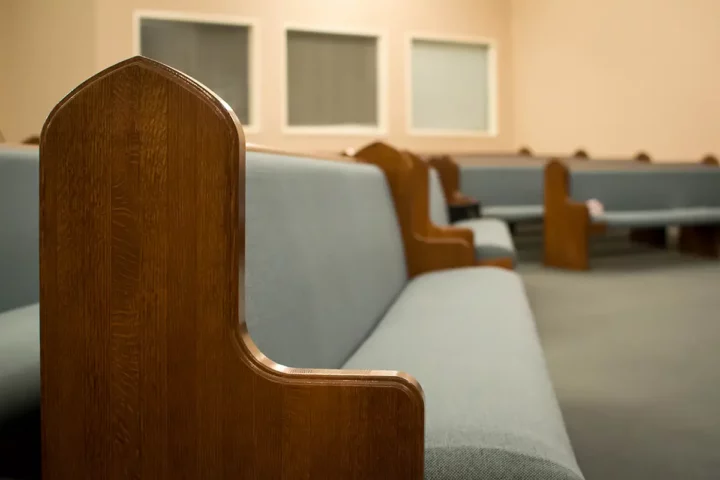
Every Sunday, before the meeting begins, as a bishop I look around the hall. I see the familiar faces, the people who have been sitting next to each other for years, the children who whisper loudly because they don't yet know how silence works. But there are also other faces. On average, every week I look at about ten out of a hundred people who are not yet members. They are there for the first, second or third time. Someone invited them, or they themselves searched on a computer for the nearest church.
Many of them do not come back.
I find that interesting every time. Because when I talk to those people about why they don't take the step to baptism, it's rarely about faith itself. Believing in something greater than yourself is not that difficult for most people. The bottleneck lies elsewhere. And precisely that bottleneck brings me to a question that goes much further than my own church: why do we actually need a church? Why is religion as an institution, with buildings, structures and rules, still valuable in a time when people prefer their own spirituality themselvescompose?
A church is not a goal, faith is.
Let me first correct something that is often stumbled upon. A church is not an end in itself. Going to church, stepping into a building on Sunday, is not what it's ultimately about. Believing in Christ and living accordingly, that is the goal. The church is a means to that end.
But a means is not unimportant. Just as a ladder is not a goal but is necessary to reach something, so a church as an institution makes certain things possible that you cannot achieve on your own. Forming covenants, performing rituals, building a community that holds you up when you can no longer do it yourself. You need that as a tool, precisely because the goal is so great.
And yet, this is precisely where the tension lies that frightens people. As soon as you use the word church, people think of power, control, structures that want to dominate the individual. That is understandable. But it is also a mistake to confuse power and influence. A church institution can have much influence without exercising power. The difference lies in voluntariness. No one is forced. Whoever stays, stays because it yields something, not because they are held captive.
The empty space left by individualism
Here, I believe, we touch upon the real core of why so many people still return, even though they feel the same suspicion towards institutions. Our current society has given the individual an incredibly large place. You determine your own values. You put together your own meaning, like a buffet where you choose what you taste. On paper, that sounds like freedom.
In practice, it leaves an emptiness. Because if everything is individual, you also stand alone. No one controls you anymore, but no one carries you either. And precisely there, a church community offers something that loose, individual spirituality cannot offer: you know that you are not alone. Not with your doubts, not with your needs, not with who you are.
That is not a plea to live in communes or to completely disregard the individual. Personal conviction and individual experience remain essential, certainly in our church. But I believe that you cannot fully reach your destiny as a Christian as a completely separate individual. Not in faith, and actually not outside of it either.
A body, not a collection of loose parts
The apostle Paul uses an image for this that I find powerful every time. In 1 Corinthians 12, he describes the community of believers as a body. Not as a collection of loose individuals who happen to sit together in the same room, but as a body in which each part has its own function, and in which no part can say it does not need the others.
That image is more than a beautiful metaphor. It is a direct attack on the idea that you can keep your faith, or meaning in general, completely private. An eye that cuts itself off from the body is not an independent eye. It is a dead eye. This is also how it works with people who want to experience their spirituality entirely on their own. It seems like freedom, but it is rather isolation with a prettier name.
Why people still drop out
However, that is not a complete explanation for why so many people feel that warmth, yet still leave. I think it is rarely about faith itself. It is about commitment. People feel the attraction of community, but shy away from the dedication that community demands.
Incidentally, this is not a problem unique to religion. Every form of lasting commitment, a marriage, a friendship that lasts for decades, a team you dedicate yourself to, asks something of you that goes beyond casual interest. We live in a time that confuses commitment with limitation. But it is precisely that commitment that truly gives value to a community. Without dedication, you don't get a body, you get a collection of spectators.
An invitation, not an obligation
I think many people who today wonder if our church can still mean something to them are actually struggling with precisely these two issues. They do not want to be controlled, and they shy away from commitment. Understandable, in a time that constantly teaches them that freedom means not being tied to anything.
But perhaps it is the other way around. Perhaps the emptiness that so many people feel is not the result of too much commitment, but of too little. And perhaps a church, despite all legitimate historical criticism and despite the mistakes that every institution inevitably makes because it is run by people, is still one of the few places where that commitment is structurally offered. Not as an obligation, but as an invitation.
So if you've been asking yourself that question for a while: just come and have a look. Not to immediately belong somewhere, but to feel what a community does to you that doesn't let go as soon as it gets uncomfortable. The rest, the rules, the structures, the answers to the big questions, that will come later. First, there's just the question of whether you're willing to stop searching alone.
Discover more from GeensZins
Subscribe to have the latest posts sent to your email.
