

Briefly summarized
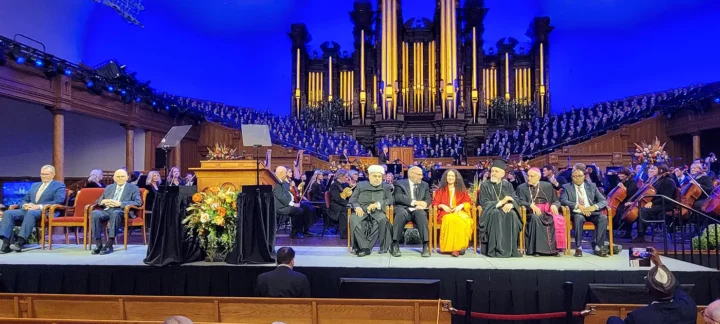
During the G20 Interfaith Forum in Salt Lake City, religious leaders, academics, and policymakers from various countries and faith traditions gathered to reflect on peace, connection, and the role of religion in our society. My friend Rik Torfs was also there. Such encounters particularly appeal to me because they show how people, from their own convictions, can build bridges to others. However, these initiatives receive strikingly little attention in the Flemish press, while religious conflicts and derailments are usuallyextensively highlighted. I find this a pity, because the story of religion is so much richer than what we usually see in the media.
When religion and violence appear together in a headline, attention is usually assured. Religious extremism, abuse within faith communities, fundamentalism and conflicts between religious groups are topics that rightly deserve journalistic interest. But when religious leaders from all over the world come together to speak about peace, cooperation and mutual understanding, it remains remarkably quiet. That is a pity, because whoever gets to know religion exclusively through its aberrations will inevitably get anincomplete picture of the place that faith still occupies in our society today.
From October 15 to 17, the annual G20 Interfaith Forum took place in Salt Lake City, Utah, in the American state. Under the theme 'Resilient Hope, Shared Future', representatives of different faith traditions, academics, civil society organizations, and policymakers gathered to reflect on the contribution that religious communities can make to a world increasingly characterized by polarization and distrust. The meeting took place in a city that holds special significance for me, asSalt Lake City is the global center of The Church of Jesus Christ of Latter-day Saints, of which I am a member and in which I serve as a bishop. The opening meeting took place in the historic Tabernacle on Temple Square, a place where faith and community have held a central place for generations.
My friend Rik Torfs was also present, which for me was an additional reason to watch this forum with interest. Rik is someone with whom I enjoy exchanging ideas, precisely because he combines a strong vision with a genuine interest in other convictions. As a canon lawyer and academic, he also understands very well that religion is not just a private matter, but also has a societal dimension. His participation in such international meetings should therefore not be surprising.Earlier this autumn, he was also involved in consultations in Brussels on strengthening the European dimension of interreligious dialogue.
Polarization begins where connection disappears
One of the most striking conversations during the forum brought together Martin Luther King III, Utah Governor Spencer Cox, and David Beasley, former director of the United Nations World Food Programme. Their discussion focused on the increasing polarization in our society, but especially on what people themselves can do to counteract it. According to Cox, beneath the political and social division lies a deeper problem, namely that more and more people feel they truly belong nowhere. We are concernedabout political events on the other side of the world, let algorithms determine what we should be outraged about, and engage in heated discussions with strangers on social media, while sometimes we barely know who our neighbors are.
Cox formulated a remarkable warning, especially for someone who is himself active in politics. According to him, politicians are not worth people sacrificing their friendships or family ties for them. He therefore called on his audience to consider their personal relationships more important than political differences. This message also seems particularly relevant for Flanders, where social discussions are increasingly reduced to an an opposition between camps that hardly want to understand each other anymore. Wetend to judge people based on a single statement, a single viewpoint, or a single conviction, causing the person behind the opinion to gradually disappear from view. However, a truly pluralistic society does not assume that everyone thinks the same, but rather that people with fundamentally different views remain willing to regard each other as full-fledged conversation partners.
In my opinion, there is also an important task for religious communities here. Faith can connect people in a way that goes beyond shared political convictions or social interests. Religious communities not only offer a worldview, but often also a network of human relationships in which people look out for each other and take responsibility for each other. Of course, faith communities themselves can also contribute to division, especially when they prioritize their own righteousnessover the human dignity of others. But precisely for this reason, I find initiatives such as the G20 Interfaith Forum so valuable, because they do not deny religious differences and at the same time try to discover how believers can jointly make a positive contribution to society.
Why I love interreligious dialogue so much
I have always had a great deal of appreciation for interfaith, or interreligious dialogue. This has nothing to do with a lack of conviction about my own faith, on the contrary. I am a convinced Christian and my faith in Jesus Christ largely determines how I look at life, which values I find important, and how I try to take responsibility towards others. Precisely from that conviction, I find it natural to show interest in people who, from another religious orphilosophical tradition, look at the same world. I do not have to relativize my faith to be able to show respect for a Muslim, a Jew, a Hindu, or a Buddhist, just as I do not expect them to weaken their own convictions to be able to engage in dialogue with me.
In my opinion, interreligious dialogue is sometimes misunderstood as an attempt to minimize the differences between religions, as if we can only work together when we agree on everything. I see that differently. Christianity, Islam, Judaism, and other religious traditions differ from each other on essential points, and those differences do not disappear by sitting around a table together. That is not even necessary, because the value of an encounter lies precisely in the possibility of better understanding each otherto understand without losing one's own identity. Anyone truly convinced of their faith should, in my opinion, also be able to muster the intellectual curiosity to discover why others come to different conclusions.
This attitude, by the way, is not limited for me to conversations between believers. I find encounters with atheists, agnostics, and freethinkers at least as fascinating, because fundamental questions about meaning, human dignity, freedom, and responsibility also come up there. We don't have to agree on the existence of God to think together about how we can build a more just and humane society. Perhaps such a dialogue even requires more courage than a conversation with someone from one's ownfaith community, because you must be willing not only to explain your own beliefs, but also to allow them to be critically questioned.
What particularly appeals to me about this is that such encounters do not have to end with mutual understanding. They can also form the basis for concrete cooperation. When people with different beliefs discover that they have a shared concern for poverty, loneliness, education or social exclusion, they can act together without first having to solve their theological differences. For me, that is not a dilution of faith, but precisely one of its most beautiful expressions. After all, for me, Christianity isa verb, something that must become visible in the way we build, help, lift and carry.
Eating together as an answer to division
During the forum, David Beasley spoke about his 'Breaking Bread Together' initiative, with which he wants to encourage people from different backgrounds to sit down together again. The premise is almost disarmingly simple: those who eat together get the opportunity to get to know each other as human beings before political or religious differences dominate the conversation. Beasley sees this as a way to combat increasing societal polarization, because personal relationships can often create more understanding thanpublic debates in which participants mainly try to defend their own point of view.
I think that's a particularly attractive idea, precisely because it doesn't have to be complicated. We have become accustomed to a debate culture in which a sharp statement receives more attention than a nuanced argument and in which admitting a valid point to the other is sometimes considered a defeat. A conversation at the table starts from a completely different dynamic, because meeting the person becomes at least as important as the substantive discussion. Whoever really gets to know someone usually discovers that a personis much more than their political preference, their religious conviction, or the opinion they express on social media.
This does not, of course, mean that all differences disappear as soon as people eat together. Some disagreements touch upon fundamental values and deserve a serious debate, where mutual respect should not be confused with the obligation to find all viewpoints equally acceptable. But a society in which we only want to speak with like-minded people ultimately loses the ability to handle conflicts peacefully. Therefore, I believe that even small initiatives that bring together people from differentbackgrounds can make a meaningful contribution to the quality of our coexistence.
Why does this receive so little attention in Flanders?
What strikes me again and again at these kinds of international meetings is how limited the attention for them usually remains in the Flemish media. When religious leaders get involved in a scandal, a political conflict, or a controversial statement, reports and analyses rightly appear about it. But when representatives of different faith traditions come together to seek solutions for societal problems, journalistic interest seems considerably less. As a result, it easily creates theimpression that religion today is primarily a source of tension and problems, while many believers and religious organizations daily contribute to social cohesion, poverty reduction, education, and community building.
I absolutely do not advocate for an uncritical treatment of religion in the press. As a believer, on the contrary, I find it important that religious organizations are critically questioned, especially when there is abuse of power, discrimination, or other excesses. But journalistic attention, in my opinion, should also be determined by the societal relevance of what people do, and not exclusively by the extent to which events create conflict or controversy. An international meeting where religious leaders,academics and policymakers reflect on peace and polarization seems to me, from that perspective, at least an interesting subject for a report, an interview or an in-depth background article.
This is not just about initiatives on the other side of the Atlantic. In Europe too, there are collaborations where religious communities seek ways to assume their social responsibility. The fact that Rik Torfs is involved in discussions about the European dimension of the G20 Interfaith Forum, for example, shows that this debate is also relevant for our region. Moreover, more journalistic interest in such meetings could be an opportunity to ask critical questionsabout their actual impact. Do they produce concrete results, do they also reach people outside the circle of religious leaders and academics, and do they succeed in translating the beautiful declarations about mutual understanding into tangible initiatives? These are questions that deserve to be investigated.
My objection is therefore not that the press would be too critical of religion, but that the broader story about the societal meaning of faith often remains underexposed. Anyone who exclusively reports on conflicts also misses the initiatives with which people try to overcome those conflicts. And anyone who primarily views religion through the lens of its problematic aspects runs the risk of not adequately appreciating the constructive role that faith communities play in the daily lives of millions of people.
Hope requires people who do something
What ultimately appeals to me most in the message of the G20 Interfaith Forum is the conviction that hope is not a passive expectation, but something that people must actively contribute to. Martin Luther King III reminded attendees that no one can change the world alone, but everyone can make a difference in their own street, at school, or within their own faith community. I find this an important thought in a time when we are constantly confronted with problems that seem so vast thatindividual efforts hardly have any meaning anymore.
As a bishop, I notice how important it is for people to belong somewhere, to be seen, and to know that there are others who look out for them. That desire for connection is not reserved for people with a certain religious conviction but, in my opinion, belongs to the most fundamental human needs. It is also one of the reasons why I believe that religious communities can still occupy a valuable place in our society today, provided that they are not exclusively concerned with themselvesbut also direct their attention to the world around them.
Perhaps that is ultimately the most important lesson I take from this forum. We do not have to give up our convictions to reach out to people who think differently, nor do we have to pretend that our differences are unimportant. What we can do is recognize that our shared humanity gives us sufficient reasons to meet each other, listen to each other, and cooperate wherever possible. For me, this is not a contradiction with my Christian faith, but rather a logical consequence of it.
I would therefore particularly welcome it if such initiatives in our media received the attention they deserve more often. Not because religion needs preferential treatment, but because a society that is constantly confronted with stories of division should also hear about people who try to establish connection. It would make our image of religion much more complete and perhaps even inspire others to do the same in their own way.
Discover more from GeensZins
Subscribe to have the latest posts sent to your email.
