

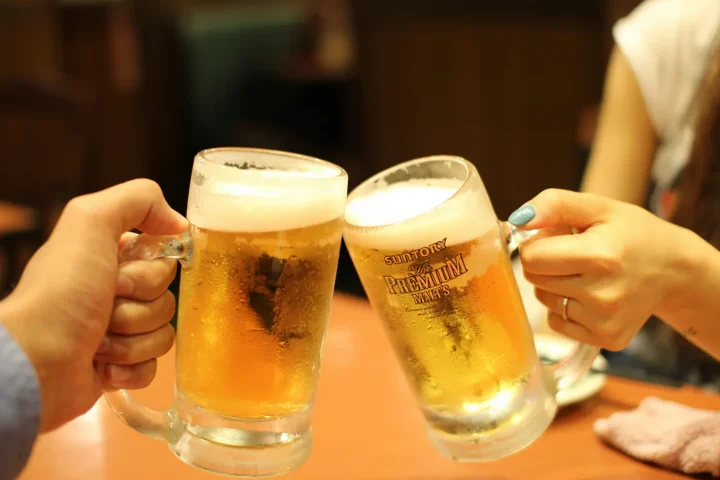
What four words under a beer ad teach me about revelation
Briefly summarized
Soon, alcohol advertisements in Belgium will no longer have to state ‘Alcohol abuse harms health’, but simply ‘Alcohol harms health’. One word disappears, but the difference is significant: not only abuse is harmful, alcohol itself entails health risks. Science has become increasingly clear about this in recent years. It reminds me of the Word of Wisdom, a revelation Joseph Smith received in 1833. I don't claim that science thereby 'proves' faith. But I do find it remarkable that areligious rule of life that could have seemed exaggerated for almost two centuries, sounds much less strange today. And that teaches me something about trusting advice whose reason I may not yet fully understand.
For years I have had to explain why I don't drink alcohol. Usually, people first think it's for health reasons, and then they look approvingly. Sensible. Healthy. Doing well. But as soon as I say that I don't drink alcohol because my faith asks it of me, the reaction sometimes changes. Then it suddenly becomes strange. Why would a church determine what you can and cannot drink? Is faith even allowed to ask something like that? Does a religion really have to take away all pleasures?
These two reactions actually say little about alcohol. They mainly say something about whom we accept as someone who can tell us what is good for us. When a doctor, scientist, or health council says that something is bad for us, we call it information. When religion asks the exact same behavior from us, we quickly call it a restriction. In recent days, this contradiction suddenly got a very concrete example in Belgium.
Four words that apparently stir up a lot
The federal government decided earlier this year to tighten the rules on alcohol advertising. Advertising via media primarily aimed at minors will be further restricted, stricter rules will be introduced for the free offering of alcohol and, above all: the mandatory health message for alcohol advertising is changing. Today it still reads 'Alcohol abuse harms health'. The new message will be much shorter: 'Alcohol harms health'. The obligation applies to advertising, not to labels or packaging of alcoholicdrinks.
That one deleted word — ‘abuse’ — is now causing quite a stir. The Belgian Brewers launched an open letter and campaign against the new wording. Their reasoning is understandable: they believe there must remain a distinction between alcohol abuse and what they call responsible enjoyment. After all, beer in Belgium is not just a product. It is hospitality, culture, craftsmanship, tradition, and even intangible cultural heritage recognized by UNESCO. Yet, that is precisely where the sticking point lies. The new message does not say thata cozy moment at the pub is wrong. It says something much more limited and at the same time more fundamental: the alcohol you drink at that moment is not neutral for your health.
No safe lower limit
That idea doesn't just come out of nowhere. The World Health Organization formulated it very clearly in 2023: based on current scientific knowledge, no amount of alcohol can be identified that is without health risk. Alcohol is a toxic and psychoactive substance and a recognized carcinogen. The risk naturally increases as someone drinks more, but according to the WHO, there is no threshold below which the risk suddenly disappears completely. Even light and moderate consumption carries risks.
That is quite a remarkable shift compared to the image many of us grew up with. I still perfectly remember the stories about the daily glass of red wine that was supposedly good for the heart and blood vessels. For a long time, the main message was: don't drink too much. Today the question is posed differently. Drinking less is better than drinking more, and not drinking avoids the health risks specifically associated with alcohol. That doesn't mean that one glass of wine poses the same health risk as a bottle perday. Of course not. It does mean that ‘moderate’ and ‘harmless’ do not mean the same thing.
And that's precisely where it becomes interesting for me as a believer.
A counsel from 1833
In February 1833, Joseph Smith received a revelation that we today know as the Word of Wisdom, recorded as section 89 of the Doctrine and Covenants. Among other things, it states that wine and strong drinks are ‘not good’ and that tobacco is ‘not good for man’. ‘Hot drinks’ are also discouraged, later explained within the Church as coffee and tea. The revelation also speaks about nutrition, grains, fruit, and the sparing use of meat.
Now I could make a spectacular story out of this: nobody thought about it in 1833, Joseph Smith could not possibly have known this and so it must have come directly from God. Only that representation is not historically correct, or not entirely. The America of the 1820s and 1830s already had a strong temperance movement. Alcohol, health, tobacco, and nutrition were widely debated. The American Temperance Society, founded in 1826, grew rapidly in those years: within five years it already had more than 170,000 members who a vowhad taken.
But what that vow precisely entailed is telling. In those years, the movement specifically targeted 'ardent spirits' — strong, distilled beverages such as whiskey and rum. Wine and beer remained explicitly permitted, sometimes even recommended as milder alternatives, and medicinal use of alcohol was still accepted. Only from 1836, three years after the Word of Wisdom, did the movement itself switch to complete abstinence from all alcohol, including wine and beer.
So when Joseph Smith banned 'wine and strong drink' together in one sentence in February 1833, he went further than even the largest and most influential temperance movement of that moment dared to go. The Word of Wisdom thus did not arise in a society where no one had ever wondered whether alcohol could be harmful — that question certainly existed, and abundantly so. But the answer given by the revelation at that exact moment went further than the answer that organized public opinion itself dared to give. That difference of a fewyears and a few words seems small, but it is precisely the kind of detail that makes the difference between 'surfing on an existing thought' and 'taking a step further than everyone around you'.
For me, that actually makes revelation more interesting, not less interesting. After all, revelation does not have to mean that God drops information from heaven that no human has ever thought about. Perhaps revelation sometimes works precisely amidst the questions and discussions of a particular time, and and then takes a slightly sharper, further-reaching step than whoever was thinking hardest at that moment. What strikes me about the Word of Wisdom, then, is not the assertion that Joseph Smith was the first person to find alcoholunhealthy. It is that this counsel, at the time already slightly more radical than the most stringent contemporaries, became part of a religious way of life that was maintained for generations — even when society later came to consider alcohol completely normal again.
Was it then a scientific prediction?
No. I would not phrase it that way.
The Word of Wisdom is not a medical research report from 1833. It does not state that ethanol is a carcinogen, give no relative risks, and calculate no safe consumption threshold. Current science therefore does not literally say 'exactly the same' as Doctrine and Covenants 89. Anyone who claims that makes the agreement greater than it actually is.
But I do find the direction remarkable. A rule of life that said: this is not good for your body, avoid it, sounded overly strict to many people for a long time. Nearly two hundred years later, our scientific knowledge about alcohol has become much more critical. Not because scientists wanted to confirm the Word of Wisdom, of course. They arrived at their conclusions by a completely different route: epidemiology, toxicology, cancer research, and gigantic amounts of health data.
And that is precisely why that agreement means something to me. Not as conclusive proof with which I can force someone else to believe, but as a confirmation within my own faith. It gives me reason to seriously consider the possibility that advice, the full meaning of which people initially do not understand, may nevertheless turn out to be wise.
And then of course comes the coffee
I have to be honest about that, because otherwise I would only choose the data that confirms my conviction. The Word of Wisdom is not just about alcohol and tobacco. Within the Church of Jesus Christ of Latter-day Saints, we also do not drink coffee and tea. And I cannot tell the same story about that today. Current research on coffee, with moderate consumption, does not convincingly point in the direction that research on alcohol points. On the contrary, various studies even find associations with certainhealth benefits.
In the past, I might have said: just wait twenty years, science will eventually discover why coffee is actually bad. But actually, I don't find that a particularly strong argument. Maybe that will happen. Maybe not at all. Perhaps in fifty years it will still turn out that a few cups of coffee a day pose no medical problem for most people.
My belief in the Word of Wisdom does not have to depend on that. With that, I come to something that I myself have increasingly come to find important: not every commandment has to be a medical prescription. God can ask people something because it is physically wise, but He can also give a rule of life because it creates identity, demands discipline, makes a covenant visible, or teaches us to voluntarily let go of something. If every religious rule of life ultimately has to be proven by a medical study, we reduce revelationactually to health advice that coincidentally was published a few centuries too early.
That seems far too limited to me.
Faith begins where I cannot yet prove everything
Regarding alcohol, I have something extra today. I can look back on almost two hundred years of church history and ascertain that a way of life often considered old-fashioned, exaggerated, or puritanical, on that specific point remarkably aligns with what health organizations say today, and that it even went further than the strictest contemporaries at the time. That does not prove to someone else that Joseph Smith was a prophet. But it does strengthen my own confidence.
And that is important to me, because faith almost by definition means that you sometimes act before you know all the reasons. If I am only willing to follow God after a scientific journal, a philosopher, and preferably a large meta-analysis have confirmed that He is right, then I have actually made faith redundant. Then I only follow what I can already prove.
Of course, that doesn't mean faith is a free pass to uncritically accept every strange assertion. On the contrary. I strongly believe in thinking, researching, asking questions, and taking new knowledge seriously. But rational thinking and trust do not have to be enemies. There can be times when I have sufficient reasons to trust a source, even if I do not yet understand every individual piece of evidence coming from that source.
We don't really like limitations
Perhaps that is ultimately what fascinates me most about the current discussion. For years, I sometimes received strange looks because my church asked me not to drink alcohol. Religion was apparently not allowed to interfere with what was in my glass. Now the government, supported by scientific research, says something that goes much less far — no one forbids adults from drinking a pint — and yet resistance arises again as soon as the words 'Alcohol harms health' must appear under an advertisement.
By the way, I understand that resistance. People quickly hear more in such a message than what is literally stated. They hear: you can no longer enjoy. Your culture is wrong. Your pleasant glass of wine with dinner is morally suspect. While the sentence actually only tries to summarize a health fact. But we humans are particularly good at defending habits to which we are attached. As soon as someone challenges them, information quickly feels like patronization.
Perhaps that is also why advice that turns out to be wise in hindsight, feels so easily exaggerated at the moment itself.
Revelation you only understand later
For those who, like me, believe that God still gives revelation today, there is a lesson in that much greater than alcohol. Sometimes you receive advice of which you immediately understand why it is wise. Sometimes only years later. And perhaps there are things for which you will never fully know the reason during your lifetime.
The Word of Wisdom therefore does not teach me that I must wait until science ultimately confirms every ecclesiastical precept. It teaches me something else: that I must not assume something is unreasonable just because I do not fully see the reason today.
That difference is important.
I used to drink something almost every day. Since I became a member of The Church of Jesus Christ of Latter-day Saints, I no longer drink alcohol. And I can honestly tell you that I haven't lost a drop of pleasure. I don't miss it. I still have enjoyable evenings, good food, good conversations, and festive moments. Only there is something else in my glass.
When I soon see the four words 'Alcohol harms health' under an advertisement for beer or wine, I will therefore not think: look, science has finally proven my church right.
I will think a little more modestly.
Perhaps that old advice was less strange than it seemed for a long time — and perhaps, at the time, it even went further than those who fought hardest against it.
Discover more from GeensZins
Subscribe to have the latest posts sent to your email.
