

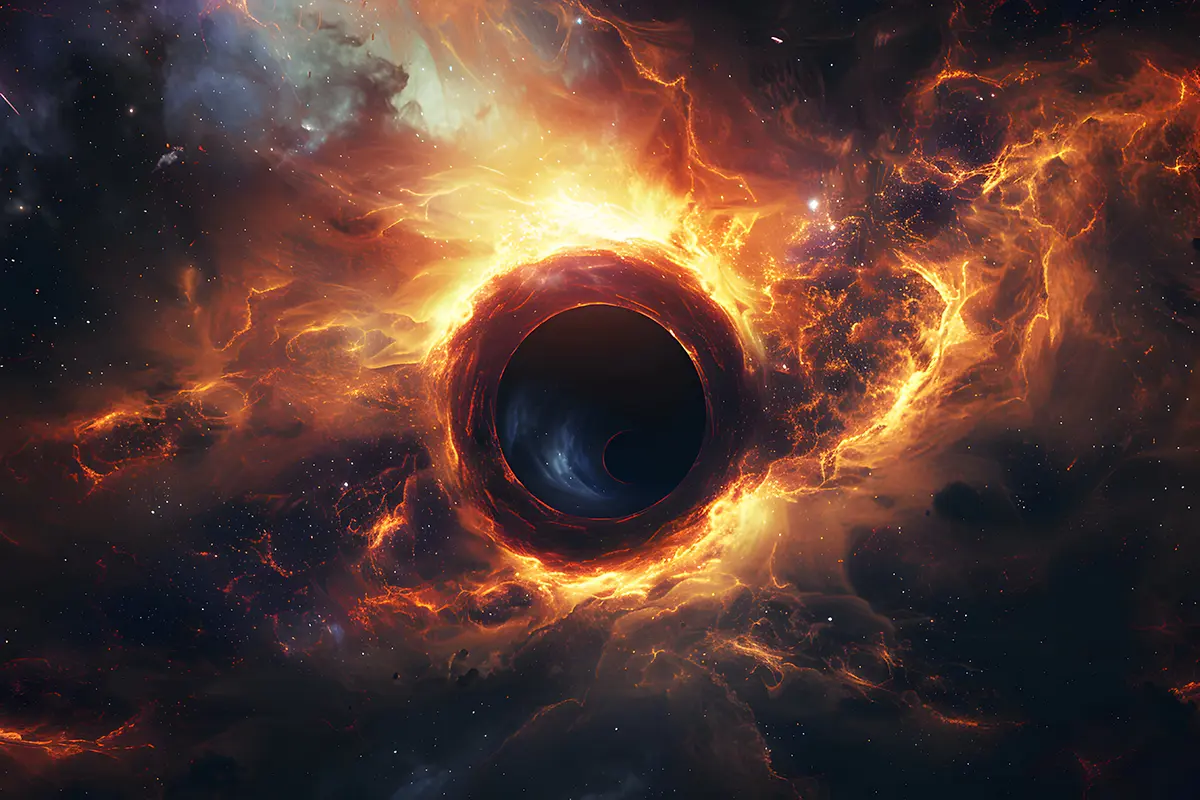
The thought alone seems to come straight from a science fiction story: that our universe might be located inside a black holeYet that idea is gaining ground among astrophysicists. Not because people have suddenly become floaty, but because certain observations — especially thanks to the James Webb Telescope — force us to redraw the boundaries of classical cosmology. And I have always had an incredible interest in physics and cosmology because it gives me the feeling of looking at God's incredible talent.
But it only becomes truly fascinating when we place that hypothesis alongside the revelations we find in the Scriptures. For what science approaches through mathematics and relativity, revelation has been expressing for centuries in spiritual language: that creation is eternal, that worlds without number exist, and that matter does not come from nothing, but lives on eternally.
The theory: a universe inside a black hole
According to modern cosmology, a black hole is a point in space where gravity is so strong that nothing, not even light, can escape. Within that 'event horizon', the boundary between space and time blurs. Some physicists suspect that the inside of such a black hole does not simply end in destruction, but can lead to a new, expanding universe — a 'baby universe'.
In that case would our own big bang be the result of such an event: the moment when a black hole formed in an older universe. What we experience as expansion would be its interior.
The laws of our universe — natural constants, the ratio between mass and energy, the curvature of space — would then be the print are of the circumstances of that birth. In other words: our universe would not be the first, and certainly not the last.
The idea remains speculative, but it appeals to an intuition that many people recognize: that creation is cyclic. There is no absolute beginning, only a continuous transition from old to new.
The eternal creation according to revelation
What strikes me is how strongly this resonates with what we read in the Scriptures. Within the Church of Jesus Christ of Latter-day Saints it has never been the intention to say that God created “out of nothing”. Joseph Smith taught the opposite: the elements are eternal, and God merely brings them into order.
In Abraham 3:24 we read:
‘We will go down, for there is space there, and we will take of these materials and we will make an earth.’
That implies that space and matter already existed before creation.
And Doctrine and Covenants 93:29 goes even further:
‘Man was also in the beginning with God. Intelligence, or the light of truth, is not created or made, and neither can it be.’
Our doctrine is therefore not linear — not a story of a starting point — but cyclic, eternal, and infinite.
And in Moses 1:33 the Lord himself says:
‘And countless worlds have I created; and those also have I created for my own purpose; and by the Son have I created them, who is my Only Begotten.’
That is a remarkable parallelism with modern multiverse theory. Scientists use terms like ‘parallel universes’, while revelation speaks of ‘countless worlds’. Both touch upon the same intuitive understanding: creation is not a one-time project, but an eternal cycle.
Where science and revelation meet
There are three striking points of contact that fascinate me:
- The eternity of matter. Relativity teaches that energy and matter cannot be destroyed, only transformed. Revelation teaches exactly the same — but with a moral dimension: what is eternal is not only matter, but also intelligence.
- The order in chaos. A black hole seems destructive, but according to some theories it can be the seed of new creation. This is reminiscent of the spiritual law that new growth emerges from suffering and chaos. Even the fall had a purpose: without it, no progress. In that sense, the universe reflects the plan of salvation itself.
- The continuity of law and order. In the 'black hole cosmos' hypothesis, new universes inherit the laws of their predecessors. Through revelation we know: 'There is a law given, irrevocable, on which all blessing is founded' (D&C 130:20-21). The same thought: every new creation lives according to eternal principles.
The difference: purpose versus coincidence
Yet there remains a fundamental distinction between the scientific model and the doctrine of the gospel. Physics only sees laws — blind, without intention. Revelation adds to that intention to it.
God does not create out of chance, but out of love. His universes do not just exist; they are there 'that men might have joy in them' (2 Nephi 2:25).
Where science struggles with the question of why anything exists at all, the gospel provides an answer that goes beyond mathematics: because there is an eternal plan of happiness.
A spiritual reading of the black hole
For me, the image of the black hole is almost symbolic. A black hole is the darkest thing we know — a place where light itself disappears. And yet, if this theory is correct, that same darkness is the source of new light, of new creation.
Is that not exactly what we also see in Christ? The deepest darkness — Golgotha — becomes the beginning of eternal life. What appears to be destruction turns out to be salvation.
In that sense, the black hole is not an enemy of faith, but a beautiful metaphor: the place where the old dies, so that the new can be born.
The eternal harmony of science and faith
Some see faith and science as rivals. Not me. One seeks explanation, the other meaning. But those who dare to see the depth of both discover that together they tell a greater story: that of a universe that lives, moves, and is constantly recreated.
Joseph Smith once said:
‘The elements are eternal; they cannot be destroyed. They can be ordered and rearranged.’
That is actually pure cosmology — but with a soul. It is not a collision of magnitudes, but a symphony.
And perhaps, just perhaps, we are indeed inside a black hole — but in the broadest, most sacred sense of the word: inside the eternal creation of God Himself.
Discover more from GeensZins
Subscribe to have the latest posts sent to your email.
