

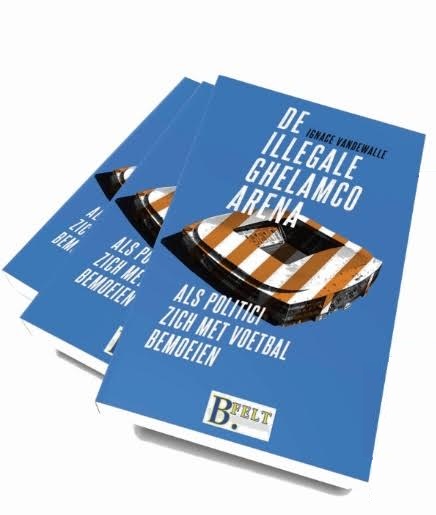
 Is the Ghelamco arena, the football temple in Ghent for first-division club KAA Gent, built illegally or not? I would never have asked myself that question without having read the book “The illegal Ghelamco arena” by Ignace Vandewalle. The title seems to immediately give the answer to the question, but actually the author more or less leaves the judgment to the reader.
I say more or less because the book provides a lot of background information and even more figures, which can sometimes make your head spin and where you certainly have to stay attentive not to lose track. The question I ask myself after reading it is whether it is complete. Because strictly objectively speaking, the conclusion can also be influenced by the author by not presenting certain information.
I myself do not have the impression that this is the author's intention. After all, he brings up many matters that have undergone a treatment that was only drawn up with the aim of gathering a lot of dust on them so that no one would ever look at them again. It is therefore naturally difficult to follow how complete this story is. I don't think Vandewalle himself knows that.
The constructions set up by the city of Ghent may have had several intentions, but never the goal of being transparent. Then it would have been solved much simpler with a public tender. Now, however, the constructions seem to serve several purposes:
- to make all transparency impossible
- to circumvent the public procurement law
- to favor friendly entrepreneurs/acquaintances
- to let some people earn good money
- to obscure how much taxpayer money was wasted
The question “illegal or not” is a legal question to which I cannot give an answer, but establishing a company where one is initially a minority shareholder, but also the largest creditor, and at the same time including in the resolutions that later (after the construction of the Ghelamco arena) the debt will be converted into a majority share, is in my opinion consciously seeking out the gray area to achieve point 2 and thus enable points 3 through 5.
Or in other words, where there's smoke, there's fire. Where complicated constructions are set up, at least transparency and possibly laws are avoided. Or to put it in a tweet by Karel Anthonissen:

Ontdek meer van GeensZins
Subscribe to have the latest posts sent to your email.
