

What a psychiatrist taught me about faith, without meaning to
Briefly summarized
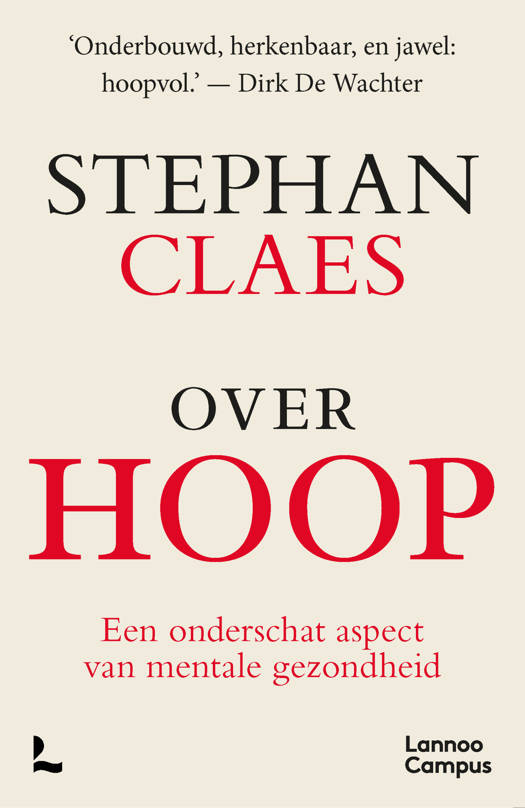
In 'Over hoop', psychiatrist Stephan Claes shows that mental healthcare too often looks only at the past and therefore leaves too little room for hope. According to him, real hope is focused on the future and on the good, differs from optimism, encourages action, and requires freedom of choice, concrete paths, and connection with others. The book is not written from a perspective of faith, but I recognize remarkably much in it of what the Church of Jesus Christ teaches about faith, freedom of choice, service, and meaning. For me, it is astrong example of faith and science as two windows on the same truth, and I highly recommend it to every bishop.
There are books you read in one sitting, and there are books you have to put down every few pages. Not because they are boring, but because you've just read something you need to let sink in. You want to place it alongside everything you already know and see where it fits. For me, those are the best books.
And there is another kind of book that I particularly love. Anyone who follows this blog knows that faith and science are two windows on the same truth for me. There are books that explicitly defend that idea, and those are valuable. But I am touched even more by books written from a single perspective, without any religious intent, and that nevertheless help me see connections. They are usually non-fiction books with a scientific slant. In them I recognize, completely unprompted, what I believe and have learned in the Churchof Jesus Christ of Latter-day Saints.
'Over hoop' by psychiatrist Stephan Claes is such a book. I haven't read a scientific book in a long time that has strengthened my faith so much.
A psychiatrist who wants to look forward
I am not going to write a full book review here. This book actually deserves one, but I mainly want to talk about what it set in motion within me. But first, briefly, the core.
Claes shows that contemporary psychiatry often falls into a certain thought pattern: the problems a person has today could allegedly be solved by digging into the past, finding the causes there, and coming to terms with them. For example, he is critical of EMDR as a trauma treatment. He does not do this to minimize trauma. He fully acknowledges that trauma lies at the root of many contemporary problems and that it deserves the necessary attention. But he notes that something essential is missing. Later in the bookhe softens that statement somewhat: he sees that there is increasingly more attention for this in his field. Nevertheless, it remains the central theme of his argument.
What is missing, the title already says: hope. According to Claes, a treatment must also look to the future, and that future must be hopeful.
You could call the book an indictment, but it is written too beautifully and subtly for that. Claes patiently develops his thesis, with many examples and strongly supported by literature. The book is primarily intended for those working in psychology or psychiatry. Fortunately, it is written so readably that those outside the sector can also benefit greatly from it. I am living proof of that.
What hope is, and what it is not
I find the strongest part of the book to be the analysis of what hope actually is. A few points have stuck with me.
Hope is focused on the future. That seems obvious, but in a healthcare culture that mostly looks back, it is a small revolution.
Hope must be focused on the good. Not every expectation is hope. Hope has a direction, and that direction matters.
Hope is not optimism. I thought this was one of the sharpest insights in the book. Optimism can be surprisingly fatalistic: ‘it will all be fine’, so I don't need to do anything. Real hope prompts action. Those who hope get to work.
Hope needs agency. The English word recurs often in the book. You cannot impose hope on people. They have to choose it themselves, otherwise treatment makes little sense.
Hope needs pathways. There must be pathways, concrete possibilities to get there. Hope without a path is a dream.
Hope sometimes needs to be modest. Hoping for the impossible helps no one. Hope sometimes needs to be very concrete and achievable.
Hope lives in connection with others. Hope does not work in isolation. Remarkably enough, Claes also arrives at altruism: those who focus on others find hope themselves.
Hope has to do with finding meaning. Towards the end of the book, it deals with meaning, and how important that becomes within psychology and psychiatry.
Agency and pathways are the building blocks of the hope model that American psychologist Charles Snyder developed decades ago. Claes often refers to it. He calls it a very good basis, but also feels that it falls short. That is why he builds further upon it: he opens it up to connection with others, to the daily practice of care, and ultimately to the big questions of life.
While reading, I got the same feeling time and again: this man could be a member of our church. It seemed as though he had applied much of what we teach to his own field.
That is not so. I have since had brief contact with him, and I know that he is a believer, so the similarities are not entirely surprising. But his book was explicitly not written from that perspective. It is the work of a scientist writing about his field. So you could call the similarities coincidental. I do not believe in that. I think that Stephan Claes has learned many things from his field of expertise that we have also learned through revelation and through Jesus Christ, but perhaps do not always fully realize.
Let me elaborate on a few of those connections.
Faith and hope belong together
For Latter-day Saints, faith and hope are inextricably linked. In the Book of Mormon, the prophet Alma explains that faith does not mean having a perfect knowledge. Whoever has faith 'hopes for things which are not seen, which are true' (Alma 32:21).
Faith is therefore at its core future-oriented, just like the hope Claes describes. And it is focused on the good: on things 'which are true'.
Another verse aligns even more closely with what Claes says about the difference between hope and optimism. In Ether 12:4 we read that whoever believes in God 'may with surety hope for a better world'. That hope becomes 'an anchor to the soul', making people 'sure and steadfast' and 'always abounding in good works'. There it is: true hope does not make you passive, it sets you to work. What Claes found in psychiatric literature had already been in our scriptures for centuries. Hope is a verb.
Choosing between good and evil
Claes emphasizes that hope must be focused on the good, and that people must choose for themselves. To me, that immediately sounds like a core theme of our faith.
Agency, also called agency in English, is essential for Latter-day Saints. That is how we understand the story of Adam and Eve and the forbidden fruit: not as a tragic mistake, but as the moment when humans received the freedom to choose between good and evil for themselves. The plan of salvation, the great story of why we are here, revolves around precisely that. We are on earth to learn to choose. In the Book of Mormon it states that man is 'free to choose' (2 Nephi 2:27).
I find it telling that a psychiatrist, based on clinical experience and research, comes to the conclusion that healing cannot happen without the person choosing for themselves. What theology teaches as a divine principle simply proves to work in the consulting room.
No one hopes alone
Perhaps the most beautiful connection is the connection with others. Claes argues that hope only works when there is connection.
We also say very clearly that faith is not a purely individual matter. There is an important personal aspect to it, but faith only comes fully into its own when you experience it together with others. That is why we gather, that is why we celebrate together. In principle, everyone could bless bread and water at home on Sunday and take the sacrament. But that would not have the same meaning. Doing it together is part of it.
In our church, moreover, it goes much further, through what we call ministering. Everyone is given the care of a number of brothers and sisters and their families. The first assignment is simple yet demanding: to serve them, help where needed, be there for them, offer a listening ear. At baptism, we promise that we are 'willing to bear one another's burdens', that we 'mourn with those that mourn' and 'comfort those that stand in need of comfort' (Mosiah 18:8–9).
That is altruism in its purest form, and it is fully embedded in connection with others. It is exactly what Claes describes.
Meaning of life and meaning in life
Towards the end of the book, Claes arrives at meaning in life. That did not surprise me, as it was in line with everything that preceded it. Of course, he does not go so far as to promote religion as a medicine. However, he quotes great thinkers, including even Nietzsche, the man behind 'God is dead'.
The analysis is sobering. When religion as a framework fell away, it was first replaced by a belief in progress: science and technology would make the world better and better. Today we live in a time when new scientific developments feel more like a threat than progress. Climate, technology, polarization: the future does not look hopeful for many people. The old framework is gone, and the replacement framework is crumbling. According to Claes, many of today's problems are related to that loss.
This piece touched me the most as a bishop. It showed me how difficult it is for young people today, and how important it is to show them that hope for the future remains justified.
In doing so, Claes makes a distinction that I remembered right away: there is meaning of life and there is meaning in life. The meaning of life, and zest for life.
As a church, we answer the first question when we teach about the plan of salvation: where we come from, why we are here, and where we are going. We do not answer the second question with a doctrine, but with a practice: service. ‘When ye are in the service of your fellow beings ye are only in the service of your God’ (Mosiah 2:17). To someone who is feeling down, we often give advice that sounds strange at first glance: forget your own worries for a moment and go help someone else. It is not stated so literally in Claes’book, but his argument essentially comes down to it.
A personal note
I am not writing this merely as a reader. After my brain hemorrhage, I spent some time without hope myself. I wrote about that in my own book.
I experienced firsthand what Claes says about realistic hope. I knew I would never be quite the same again. Hoping for a full recovery would have been hoping for the impossible. But I could hope for improvement, and for a life that would be meaningful again. Thanks to the intervention of Jesus Christ, I learned that. He literally told me that my life would still have meaning, and that I would find the strength to move on.
In hindsight, I see all the elements in it that Claes describes. My hope was focused on the future and on the good. It was concrete and achievable. I had to choose for myself to go for it, that was the agency. Ways had to be found, those were the pathways. And I didn't do it alone. The most important lesson I passed on in my book is that we can always find the strength to address our problems. Not because everything will turn out fine as the optimist thinks, but because hope sets us in motion.
Why every bishop should read this book
After the intellectual exercise of connecting all these dots, one practical conclusion remains for me. This is a book that actually every bishop in our church should read.
As bishops, we are often confronted with people in psychological distress. Let's be honest: in many cases, we are amateur caregivers. We are not therapists, and we shouldn't pretend to be. However, this book shows why what we teach matters: hope, agency, connection, service, and purpose. It provides scientific confirmation that what we teach every week is not without value.
The confirmation also works in reverse. As a believer, I can say with conviction that Stephan Claes hits the nail on the head regarding what is needed in mental healthcare. Two windows, one view.
In conclusion
'On Hope' is a wonderful book: well written, solidly backed, human, and necessary. It was written by a psychiatrist for his colleagues, but it is a gift for anyone who wants to reflect on what truly helps people move forward.
I kept putting it down to think, and picking it back up feeling that I recognized something I had known for a long time, but had never seen so clearly.
I recommend it to everyone. A great book.
Discover more from GeensZins
Subscribe to have the latest posts sent to your email.
