

It is always said that thanks to the Enlightenment we live in a secular society. In recent weeks, it is often said that the exceptional protection of religious freedom should be removed from the constitution because it does not deserve separate protection. However, the statements of various politicians indicate that they want to move further towards laicism, and then religious freedom certainly deserves some attention.
Clear concepts
 I notice that in the entire discussion a number of concepts are used interchangeably. The Enlightenment, for example, is a movement from the 18th century. It has brought us the advantage that reason must prevail over pure dogma. Secularism has emerged from this way of thinking.
In a secular state there is a separation between Church and State. This means that there should be no entanglement between religious authority and government power. This means that the state tries to adopt a neutral position towards all religions, insofar as they fully recognize and respect civil law.
Or in other words, the separation between church and state means that the government may not interfere with the internal affairs of religious communities and that (one) religion or worldview does not dominate public space. In our country, it has never meant that religions should not be allowed to manifest themselves in public.
If one prioritizes the latter, then we speak of laicism, as in France. The basic principle is still that the church does not interfere with the state, but equally vice versa. At the same time, religion is kept out of the public domain, meaning that expressions of faith do not belong in government buildings and public schools, etc. It considers faith a private matter, but nowhere states that one may not publicly profess one's faith.
Religious freedom
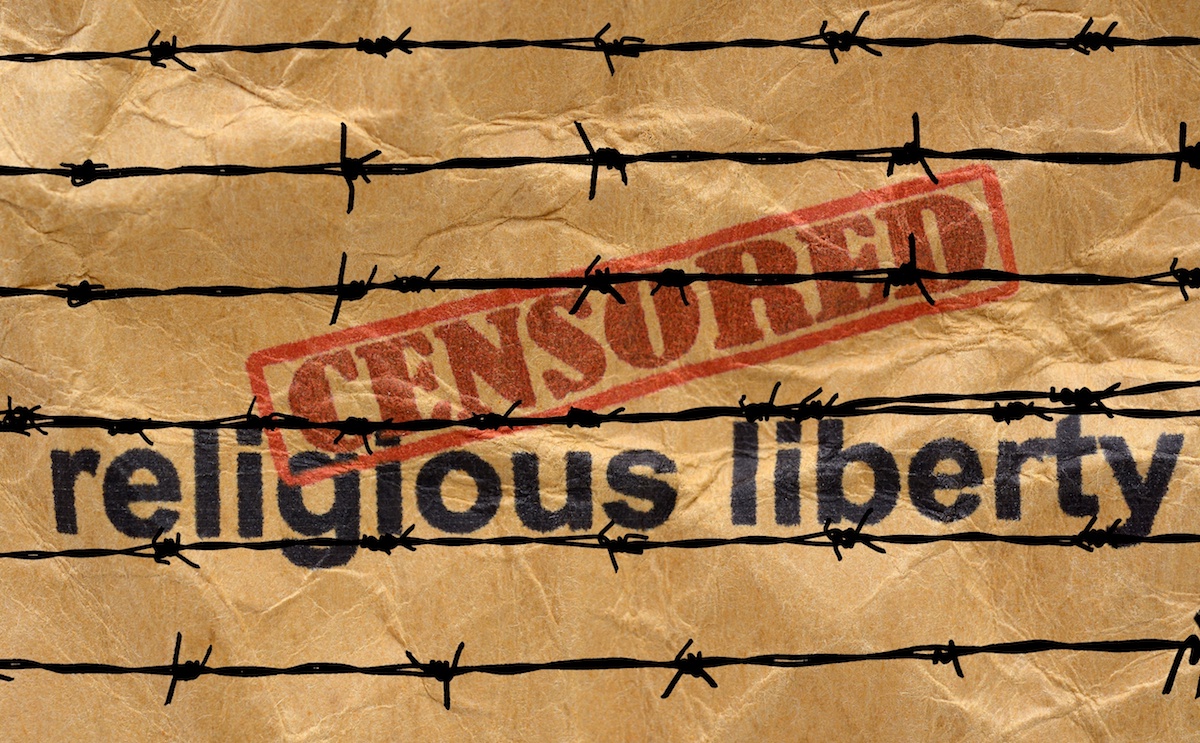
I want to push back against the various people who are now going even further than the goal of laicism and want to suppress all expressions of faith, not only from the public domain but from all public land. The meaning of “faith is private” is being changed to “faith is only allowed in private.”
There is nothing wrong with religion within the norms set by the Enlightenment. A religion may indeed not place itself above laws and may not dominate the state. But a religion may certainly play a role in the public domain through every believing citizen.
There is nothing wrong with someone basing their opinion on their faith. An argument against, for example, abortion based on faith is equivalent to any other argument, pro or contra. In my opinion, explicitly excluding such opinions is rather an admission of the lack of an equivalent counter-argument, although it is actually simple. Opposite “I believe” is simply “I do not believe”. But many people are currently so far removed from faith that even a sentence with the word faith in the negative becomes difficult.
Because not believing is actually the same as believing. Just look at how hard atheists are currently doing missionary work to convince everyone that not believing is the best choice. Hopefully, they won't discover the pyre as a tool in their zeal for conversion.
Protection for everyone, including non-believers
Voices have long been raised to abolish freedom of religion. This would be superfluous if there were freedom of assembly and freedom of speech. What has been proclaimed in the media in just a few weeks shows that this is not true. Religion apparently does need extra protection. If only because most spasmodic expressions of anti-faith are motivated by the fear of one religion dominating everything.
I think, however, that if one stops giving special protection to freedom of religion, one – and by that I mean those who are currently attacking freedom of religion – will regret it because it might just be the best protection against the domination of one religion over all others.
The secular worldview, radical laicism, is the new norm. All other worldviews may only exist insofar as they do not violate the norms formulated from this worldview.
This is at odds with what is described as freedom of religion in the Universal Declaration of Human Rights. This means that everyone can experience, express, and organize their life conviction and, from this conviction, contribute to the discussion about questions that shape our society.
If we are truly enlightened, we do not exclude opinions a priori. On the contrary, we dare to question them and talk about them. But as long as faith does not threaten the freedom of others, there is no need to threaten the freedom of faith.

Discover more of GeensZins
Subscribe to have the latest posts sent to your email.
