

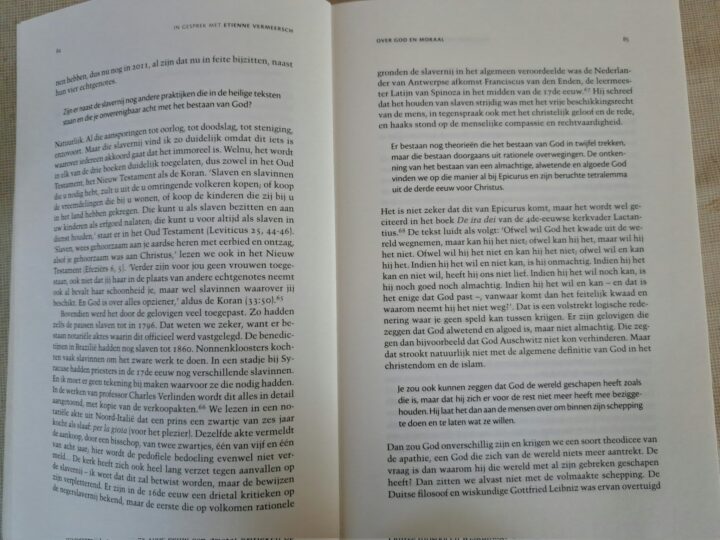
Someone recently asked me the question that I often get: why I consider faith important when there is science (a question I have, by the way, already literally answered before on this blog)? In response to my counter-question, I did not receive my own reasoning, but two pages from an interview book with Etienne Vermeersch. I read them twice. Not because I was shocked, but because they precisely hit the core of what, I think, went wrong with Christianity, and what came back with the restored gospel.
On those pages two things happen. First, Vermeersch is asked whether, besides slavery, there are other practices in the holy texts that he considers incompatible with the existence of God. He calmly answers: slavery is simply allowed, in the Old Testament, in the New Testament and in the Quran, and the church has effectively practiced it for centuries, up to the nineteenth century. Afterwards, the conversation shifts to something more fundamental: the problem of evil. Vermeersch cites the famous reasoning attributed via the earlychurch father Lactantius to Epicurus. Either God wants to remove evil and cannot, then he is not omnipotent. Or he can and does not want to, then he is not good. Or he neither wants nor can. Or he both wants and can, and then the question remains: why is evil still there?
It is a strong piece of text. And it becomes even more interesting if you know who wrote it.
A Jesuit who never got the full answer
Etienne Vermeersch did not just become an atheist. As a young man, he joined the Jesuits, followed a priestly education for years in the Old Abbey of Drongen, and only left the order after five years, dissatisfied with the church as an institution. He then continued for decades to think, write, and reason from precisely that one image of God he had received there: a God who created the world from nothing, who is absolutely omnipotent, who knows everything, and who is completely good. That is the image of God in classical Catholicism, and itis also the image of God against which his entire later oeuvre takes a stand.
The problem is that this is precisely the image of God within which Epicurus' tetralemma cannot be avoided. If God can truly do everything, without any limitation, and if He literally created the world out of nothing according to His own will, then the question 'why did He nevertheless allow all that suffering' is almost unanswerable. Vermeersch has thus, with all his perspicacity, exposed a real limit of his own education. Not a flaw in his logic, but a gap in the theology he was taught.
And that gap is precisely what the Book of Mormon has an explanation for. Nephi sees in a vision how, after the time of the apostles, 'many plain and most precious parts' are taken away from the gospel (1 Nephi 13:26-29). Not falsified out of malice per se, but lost, forgotten, worn away through centuries of human tradition. The prophet Amos had announced it centuries earlier as a 'famine... for hearing the words of the Lord' (Amos 8:11), and Paul warned his own congregations that after his departurean 'apostasy' would come (2 Thessalonians 2:3). What Vermeersch was taught as a Jesuit was therefore not the fullness of what was once known about the nature of God. It was a system that, frankly, had been struggling for centuries to answer precisely these kinds of questions. No wonder that one of the sharpest thinkers who was ever taught it, ultimately got stuck on it.
Slavery: law of a people, not law of eternity
Start with the first point. The text passages Vermeersch cites are indeed there, and by our standards they are simply terrible. There is nothing to gloss over. But the question is not whether those texts exist. The question is whether they are the last word of God, or the temporary word of God to a people who could not yet bear more.
In the Book of Mormon, the prophet Abinadi says something directly related to this about the law of Moses: that law was given to Israel because it was 'a stiff-necked people,' 'quick to commit iniquity' (Mosiah 13:29). It was not an eternal moral blueprint; it was a strict, restrictive law for a people at a certain stage of their history. The Doctrine and Covenants states it even more sharply: commandments are given 'according to the weakness' of men, 'in the manner of their language,' so that they can come to understanding (Doctrine and Covenants 1:24).Revelation, therefore, is never detached from the people who receive it. It comes filtered, adapted, in pieces that a people at that moment could comprehend.
That principle does not only apply to Israel three thousand years ago. It applies to every community of believers, including mine. Until 1978, in my own church, there was a restriction on the priesthood for people of Black African descent, and in the 1850s, slavery was legally permitted even in the Utah territory inhabited by Mormon pioneers. My church itself, in 2013, openly acknowledged this and explicitly rejected the theories that once had to justify it as human error. I am not telling this to torment myself,I tell it because it precisely confirms what I claim above: revelation grows, through people, through time, as a community can bear more light (2 Nephi 28:30). Whoever uses that principle only to defend the Bible, and looks away from their own history, uses it unfairly. Whoever applies it consistently, also to themselves, may also use it to read the Bible as it should be read: as human testimony of Divine revelation, not as a timeless law book.
And there is a deeper criterion to distinguish what bears and what is dragged along. Lehi teaches his son Jacob that people 'are free to choose liberty and eternal life... or to choose captivity and death' (2 Nephi 2:27). Agency, in my theology, is not just one value among others; it is the organizing principle of the entire plan, so fundamental that it was already under discussion before the creation of this earth. Slavery is the most radical denial imaginable of precisely that principle. When a sacred text allows slaveryallows, that is by definition the human element at work in that text, not the Divine.
Evil: a different premise than Epicurus assumed
Now for the heavier part. The tetralemma only works if you assume three things together: God can literally do anything, without any limitation, God is perfectly good, and God created the world from absolute nothingness according to his own design. Under these three assumptions, the question 'why then evil' is almost inescapable, and that is precisely the God of classical Christianity, also of Islam, as the text I received itself already notes. Moreover, it does not fundamentally differ from the famous statement by Stephen Fry that I also regularlyreceive and where I already wrote about.
My theology has never shared all three of those assumptions, and that is not a later escape trick, it has been there since Joseph Smith's first revelations. Matter is eternal, not created out of nothing (Doctrine and Covenants 93:33). Intelligence, the essence of who we are, is neither created nor made, 'nor can it be' (Doctrine and Covenants 93:29). Freedom of choice is therefore not a favor that can be withdrawn at any moment, it is a characteristic as old as God himself. And God acts within an eternal order of laws,not as a will that stands above every law and every other eternal reality.
This changes the nature of the question. It is not answered with a cheap truth: ‘God is apparently not omnipotent’, but with something more fundamental: a world in which true love, true virtue and true choice are possible, requires the real possibility of their opposite. Lehi puts it this way: ‘there must needs be an opposition in all things’ (2 Nephi 2:11). Without the possibility of bitter, no sweet; without the possibility of evil, no justice, no joy. A world that makes evil technically impossible from the outset,is not a better version of this world. It is a world without the possibility of truly choosing or becoming anything. That is why Lehi can also say that ‘Adam fell that men might be; and men are, that they might have joy’ (2 Nephi 2:25). Not as conclusive proof, but as the framework within which my trust stands: this life is not a glitch in an otherwise perfect plan, it is the place where growth towards God truly means something.
I want to remain honest about this, because easily rationalizing things away is not faith, it is self-deception. This framework explains well why people harm each other. It explains less easily why a child falls ill without ever having been able to make a choice themselves, or why an earthquake affects innocents. Philosophers have largely abandoned the strictly logical version of Epicurus' reasoning, as it is cited here via Lactantius, as conclusive proof, precisely because, as I did above, it contains a hidden assumption about thenature of omnipotence. But the more profound question of why there is so much suffering and why it seems so unevenly distributed remains open, even for me. My theology does not provide a painless answer to this, only the confidence that this suffering, too, will eventually find its place, and a restoration, within a larger whole that I do not yet fully comprehend.
What has been returned
When I clicked away those two pages, I didn't feel that my faith was attacked. I felt that I saw exactly why the Catholicism in which Vermeersch was raised could never fully answer these kinds of questions, and why he, rightly, was not satisfied with the answers he received. The problem was not with his logic. It was with the pieces of truth that his church no longer held: that matter is eternal, that free agency is as old as God, that opposition is not an accident but a condition, and that revelationalways comes according to the degree to which a people, or a person, can bear them. These are precisely the pieces that have returned with the restored gospel.
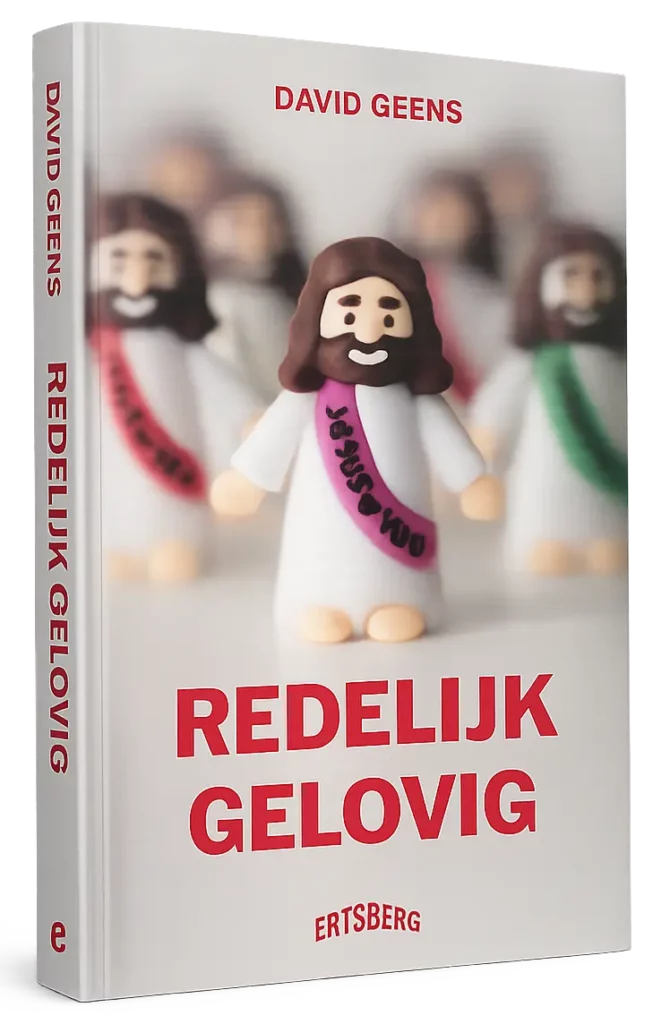
I think it's a very good question anyway. That's why it appears on my blog in different ways and is partly also the reason why I wrote my book 'Reasonably Religious'. It is certainly not a direct answer to this question, but it is an answer to the question of why I still find faith useful in these times. The book will be released on September 15th and can be ordered (in a signed version) at www.redelijkgelovig.be.
Discover more from GeensZins
Subscribe to have the latest posts sent to your email.
