

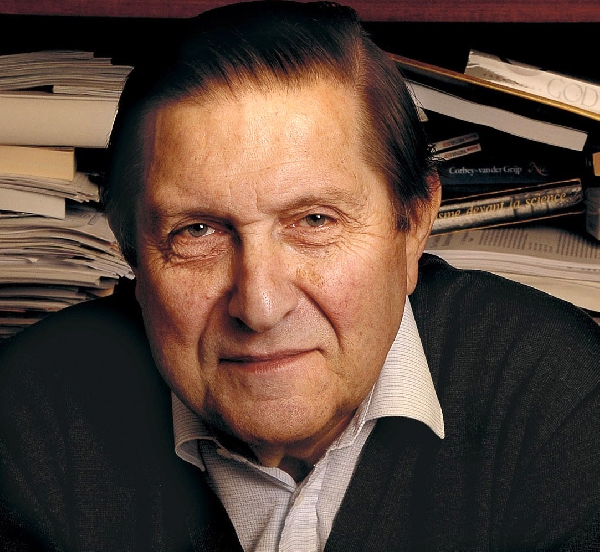
 In his book “About God” Etienne Vermeersch extensively discusses this question and gives a comprehensive answer, based on – according to him – pure rationality, and concludes “no, the god of Christians does not exist”.
Vermeersch has a special relationship with God. He was raised Catholic and even entered the Jesuit order. Therein lies the first catch. He speaks of the god of Christians, but many of his arguments relate to the god of Catholics.
Why is there misery in the world?
A large part of his reasoning is built around the proposition “if an omnipotent, all-good god exists, why is there so much misery in this world?”. A legitimate question, which I often asked myself in the past and also asked priests of various levels within the Catholic church. And I never received a satisfactory answer then, so I can still have a lot of understanding for people who struggle with this question and, from this struggle, encounter faith problems.
 I am not an academic like Vermeersch, and a large part of his book, especially towards the end, contains, like any academic's argument, a lot of references to other academics. Such references add more weight to an argument, I presume.
In exact sciences, I can understand that. What someone else has already proven, you don't have to prove again. Referring to the proof in your argumentation is then sufficient. In a science like philosophy or theology, I find that there are hardly any conclusive proofs. These sciences deal with human understanding, which is actually so individual for each of us that it cannot be grasped in a comprehensive proof.
Apart from that, I haven't read all those books, so I can't discuss with the academic Vermeersch on the same level as him. However, I can do so as a believer.
A sufficient answer for me: the Plan of Salvation
As a Mormon, I nowadays have a sufficient for me answer found to the question about suffering. This is related to the comprehensive view of Mormons on the basic questions of who we are, where we come from, where we are going, and why we are here. In our church, it has a name: the Plan of Salvation of our Heavenly Father.
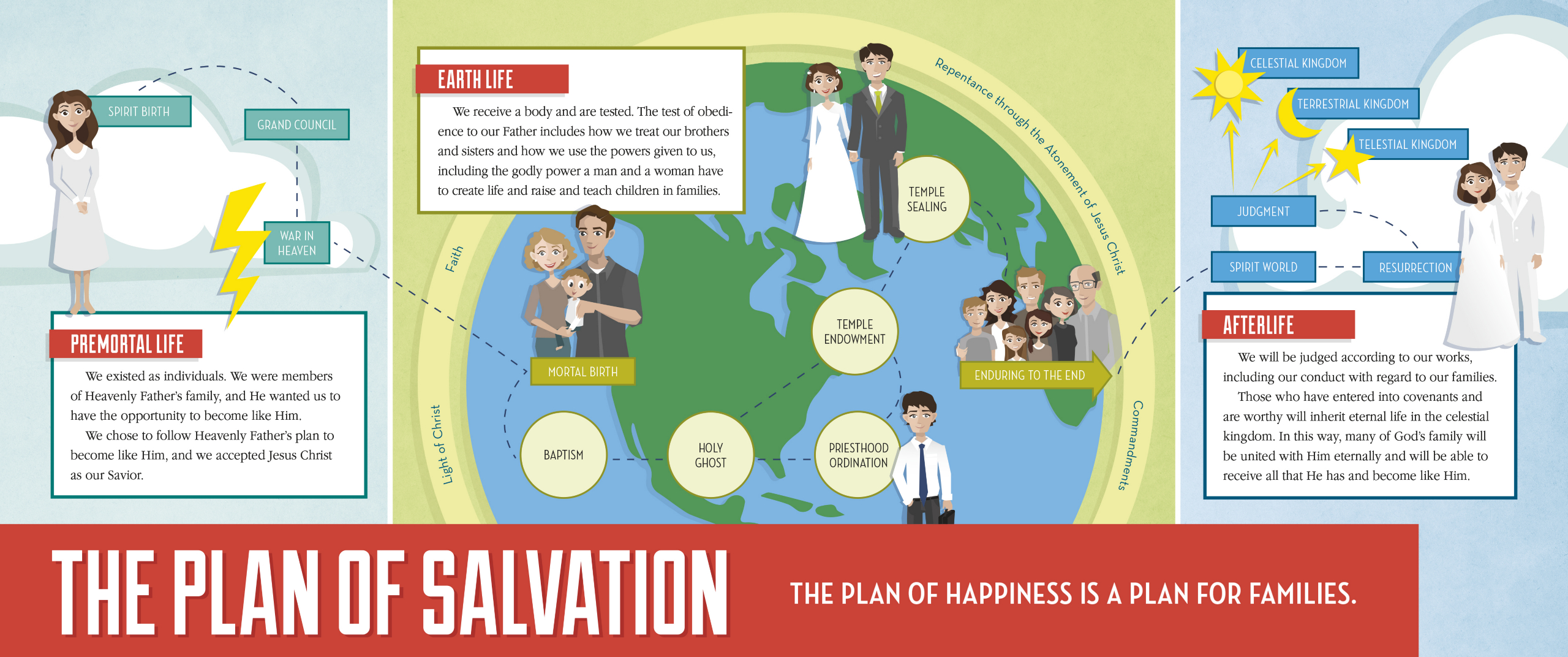
Some people study this theological concept their whole lives, thick books have already been written about it, so I must limit myself here to a simplistic summary that might risk missing some nuances.
But in essence, it comes down to this: we are all spirit children of heavenly parents and have long dwelt with them. But just like our children here on earth, there comes a time when they must stand on their own feet and learn through their own experience. That is why we are here. A time when we remove the training wheels and learn to ride a bike.
For the goal is that we return hereafter and continue to learn, until we are one day true heirs of our heavenly parents. If you can accept that we are children of a god, then it is not illogical to state that we ourselves have the capacity to evolve until we can be a god.
Mormons are often laughed at for this, but for me, this is just as logical an approach as the reason Vermeersch employs.
Adversity provides the opportunity for growth
 From that perspective, I understand much better why there is suffering on a personal level. I quite like the saying “there is no growth in your comfort zone and no comfort in your growth zone”. Adversity is negative unless adversity is viewed as an opportunity to learn and do better next time.
And that next time you should also view it in the light of eternity. Because usually when I explain this, the questions arise: "what is the purpose of the suffering of a child who gets cancer and dies at a young age?". If you do not believe in an eternal Plan of Salvation, in a future in which we can experience a happiness that we cannot grasp, then it is also unimaginable that you can imagine that perhaps a child who dies young was already so much further in their progress before coming to earth, that they perhaps only still had tolearn to deal with pain.
I also do not have a perfectly conclusive answer to every individual question. But again, if you believe in a plan of progress and a god who knows so many more dimensions than we do, then you cannot but accept that we as humans, with potentially divine ability, do understand a part of all knowledge, but not its totality. In this plan of progress, understanding everything will mean that we have reached the point of being a god ourselves. Up to that point, we must accept that we do not know everything and continueto learn more.
At this point, I often hear “yes, that's easy to explain”, but does this differ from, for example, a surgeon? When he starts his studies, is he immediately a top specialist in his field? No, he only becomes that after many studies, internships, gaining experience and going through the necessary setbacks.
As logical as Etienne Vermeersch
But I find it a logical explanation that has just as much value alongside Vermeersch's explanation. Because ultimately it comes down to making the ultimate choice: do I believe in God or not. That is another part of the Plan of Salvation: free choice. Note: this means that a person can choose freely without being a puppet of Heavenly Father, but this does not mean that we can choose to escape the consequences of our choices. Whoever chooses to cross the highway blindfolded inherently accepts with their choice that they maybe run over.
And there would be no freedom of choice if God were to constantly intervene. Because that question probably also comes to your mind: "if God is so almighty, why doesn't he, for example, prevent the war in Syria?" Firstly, if God were to intervene in our lives, is he then a tyrant by virtue of his omnipotence or not? Secondly, a lot of misery is the free choice of people. Who knows how much further along we would be if we were to invest all the money currently spent on defense into medicine?
Happiness through strong faith
 Vermeersch challenges everyone to debate him. However, I cannot hit him with entire books, I am not an academic. And everything can always be reduced to “yes but, that’s not a rational argument, that’s a purely religious argument”. Indeed, that’s how you can always reason about your opponent and essentially kill the debate. Not that I accuse Vermeersch of that, I can only judge him by his books and public appearances. I heartily grant him his strong belief in the fact that there is no God. Because I do knowone thing: a strong belief can make someone happy. For him, that is the belief that there is no God, for me, that is the belief in a comprehensive Plan of Salvation.
Ontdek meer van GeensZins
Subscribe to have the latest posts sent to your email.
