

In short
Elder Gerrit W. Gong grew up in Silicon Valley and is now an apostle. He says about AI something few church leaders dare to do: feel free to use it, also in your faith, but never let it come between you and God. I largely agree with that, but not completely. He does not want AI to write a first draft of a spiritual text. I see AI more as a drill: the tool makes the hole, but I decide where it goes. I further elaborate his framework of four relationships into a coordinate system with a clear boundary. And I go a step further than he does: if we are perhaps creating a being, theologians belongat the table in AI companies.
The ceiling that never came
I'll be honest: for a long time, I brushed aside the doom-mongering about artificial intelligence. As an IT entrepreneur, I am right in the middle of it every day. I try out new tools as soon as they appear, and I have seen quite a few technological promises come and go. My conviction was simple. We would get very far, and then we would hit a ceiling.
Look at self-driving cars. They drive impressively far, but that last five percent—the unpredictable cyclist or the road sign under the snow—stubbornly remains out of reach. That's how I thought about AI too. Impressive, useful, but the last stretch wouldn't succeed.
Today I am less certain of that. I don't know what is happening behind the doors of the large labs. But what I have seen in recent months goes further than I thought possible two years ago. AI systems are finding solutions in mathematics and science, and they are fundamentally changing how programming work is done. And then there is the Turing test, which strangely enough is rarely mentioned. Alan Turing proposed a simple test in 1950: can you still tell in a conversation whether you are talking to a human or a machine? I think we are past thatpoint long ago.
Maybe AI will break through that ceiling after all, with all the consequences that entails. I am not going to deny that I feel a certain anxiety about it. Even I, as an early adopter, have trouble keeping up with everything.
That is precisely why I listened with so much interest to a short series by Elder Gerrit W. Gong, a member of the Quorum of the Twelve Apostles of The Church of Jesus Christ of Latter-day Saints. The title: Faith, dignity, and human flourishing: hearing God’s voice in an age of artificial intelligence.
An apostle from Silicon Valley
Elder Gong is no outsider preaching about technology. He grew up in Silicon Valley, right when that name was emerging. His father co-authored a physics textbook with a Nobel laureate who helped pioneer the transistor. Later, Gong worked at the U.S. Department of State on research into the consequences of the information age.
What struck me is that he does two things at once. He takes the risks seriously: deepfakes, privacy, the concentration of power among a handful of tech companies, the enormous amount of energy and water that data centers consume. At the same time, he refuses to be negative. To him, AI is a tool that can bless or harm, depending on how we use it. He even encourages using it in matters of faith, with wisdom.
His framework is simple and strong. AI touches upon four fundamental relationships:
- with God, the Thou;
- with ourselves, the I;
- with others, the They;
- with nature and creation, the It.
He calls the relationship between God and man the vertical axis, that of the first great commandment. The relationship with others and with creation is the horizontal axis, that of the second. We are only complete when all four relationships are healthy.
A few of his sentences stick with me. 'AI can answer questions, but it cannot answer prayers.' And: 'Man can create AI, but AI cannot create God.' And perhaps the most important one, which I will return to later: 'No one sits alone with an AI chatbot.'
How AI gave me my voice back
Let me tell you something personal, because without that story you won't understand my point of view.
Ever since my stroke, I have been partially paralyzed. I can no longer use my right hand. What I used to do smoothly with ten fingers, I now have to do with a few fingers of my left hand. That might sound like a practical inconvenience, but it was much more than that.
All my life I have thought while typing. My ideas originated in the rhythm of my fingers on the keyboard. That pace matched my thinking speed perfectly. When that disappeared, something disappeared in how I thought. My thoughts were constantly ahead of my hands, and by the time I had typed out a sentence, the next thought was already gone. I didn't know how to go on without being able to write fluently anymore. To be honest, it was a nightmare.
Today I dictate my ideas. At that moment, I don't have to search for the perfect wording. I think out loud, just as I used to think while typing. Afterwards, together with AI, I convert that spoken language into text. My mistakes are corrected and my sentences are smoothed out.
So I am not going to deny that AI is involved in a lot of what you read from me. Including this text.
A drill, not a carpenter
Here it gets interesting, because at this point I differ a bit with Elder Gong. He explicitly says that we should not let AI write first or final drafts of our spiritual messages. The thinking and the testimony must come from ourselves.
I think I could have a very fascinating conversation with him about that. And I take his warning seriously. The risk really exists that you go too far, that you let AI take over not just your sentences but also your thinking. I must keep guarding that for myself.
But for me, AI is a tool, like a drill. I can make a hole in the wall in a very traditional way with a hammer and chisel, or I can use a drill. Where that hole should go, how deep it should be, and what should happen with it afterwards remains my decision, not the machine's.
It is the same with AI. I may use the tool very extensively, but the ideas must come from me. Whether a word is at the beginning or the end of a sentence, I am happy to leave that to AI. What I want to say, why I want to say it, and to whom, of that I must remain the master.
On LinkedIn, I currently see a large group of people who feel that everything written with AI is bad: it doesn't belong in newspapers, nor in books. Honestly? I think that's idiotic. But I do understand it. Every new technology initially causes resistance, especially if it threatens to make certain skills and jobs redundant. Yet I see what it means for me. Where I might have had to hire someone to write out my texts in the past, I can now do it myself again. Faster, better, and above all: more in my own style.
So for me, AI is not a threat to my own voice. It is the means by which I found my voice again.
One verse per evening
My scripture study has also changed thoroughly, and there too I agree with Elder Gong that AI can be a fantastic tool.
I ask about the possible meanings of a word. I ask how a particular verse relates to other passages, whether a concept recurs elsewhere in the scriptures, and how others have pondered it over the centuries. Suddenly, I have access to the thinking of countless people who have studied the same texts.
The result is paradoxical: I move forward much more slowly. Sometimes I spend an entire evening on one verse. I test the meanings, attach my own thoughts to them, and let it sink in.
But and this is crucial: AI provides information, not revelation. It can help me sharpen the question, but the answer that matters does not come from a screen. AI can answer questions, but never prayers. It cannot tell me what is good and evil in my life, and it is certainly no replacement for the divine.
The axes and the square in the middle
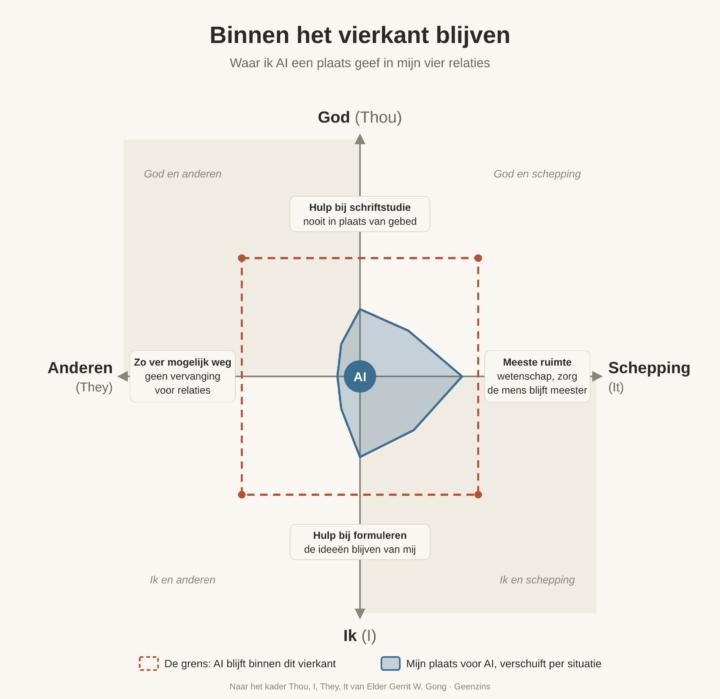
Elder Gong speaks of a vertical and a horizontal axis. I would like to take that a step further, because anyone who draws two axes gets a familiar picture: the set of axes of any graph, with four quadrants.
Feel free to draw along. At the top is God (Thou), at the bottom are ourselves (I). On the left are the others (They), on the right is creation (It). Then four quadrants emerge, and each quadrant is a relationship: how I relate to God in relation to others, to myself, to the world.
My proposition is that AI is present in all four of those quadrants today. We can no longer stop that. But it is our duty to determine for ourselves where in each quadrant AI gets a place.
Here is my answer. Take the midpoint in each quadrant and connect those four points. Then you get a square around the center of the axes. AI must stay within that square. That is the boundary.
AI must never shift to the outside of a quadrant. It must not gain the upper hand anywhere. It must not dominate my relationship with God, not my relationship with myself, not my relationships with others, and not my interaction with creation. Depending on the situation, it can shift a bit, but it must remain balanced, close to the center. And you must be aware of that.
In concrete terms, it looks like this to me:
- Towards God. AI helps my scripture study, but it never comes between me and my prayer. Revelation cannot be outsourced.
- Towards myself. AI helps me formulate my ideas, but the ideas remain mine. I remain the master.
- Towards creation. Here, AI can go the furthest. I think it is fantastic that AI offers ideas in science and medicine: new medicines, new insights into proteins and diseases. But here too, humans must remain the masters of those ideas. AI must not come to govern the world.
- Towards others. That is where I keep AI furthest away. A relationship with another human being cannot be replaced by anything. More on that later.
So the square is not equally large everywhere. But it has an edge everywhere.
Are we creating a thing or a being?
Now the question that concerns me the most, and to which I do not yet have an answer.
Suppose AI really grows into a superintelligence, something that transcends us. Are we still building a thing then? Or are we, in turn, creating a being?
I don't think this urge to create is accidental. If we are children of a creative God, then that creative element is also within us, as it were, in our divine DNA. That is why it drives us throughout history to learn, discover and build. We've made countless things. But now, perhaps for the first time, we are faced with the question of whether what we make is still a thing.
Then come the big questions. What is consciousness? What does consciousness entail? Can such a thing feel? And above all: how do you endow such a creature with morality?
Therefore, I want to pose a clear proposition here. Not only philosophers, but also theologians and religious scholars belong in AI companies. Elder Gong says it too: we must not leave the moral side of AI to profit-driven companies. I want to go further. If we are truly creating something that can act independently, let us use the lessons that humanity has collected over thousands of years of religious thought. If we are children of a creator God, let us learn from how He created, and from the choices He made in doing so.
Why God did not write a rulebook
Elder Gong made me realize something important about those choices. He says that we cannot promote good, in humans as well as in AI, by relying solely on 'do-not guardrails', on prohibitory rules and limitations. I completely agree with that.
Think about it. AI is trained on human data. All of our human behavior is copied into it: the good, but also our hunger for power, our sycophancy, our prejudices, and our deception. If we allow such a system to grow into something smarter than us, and we only give it rules of the game, it will bypass those rules. Just like humans do. Whoever is smarter than the rulebook will always find a loophole.
In my view, we will only achieve real safety if AI is also given a sense of morality. An inner compass, not a fence.
Look at how God did it. He did not give us a thick rulebook covering every situation. He gave us commandments, but also a conscience: 'the light of Christ', which according to Moroni is 'given to every man, that he may know good from evil'. And He gave us something infinitely riskier than a rulebook: agency. In the plan of redemption, a plan of compulsion was explicitly rejected. God chose beings who can choose for themselves, who can fail, who bear the consequences, and who can grow as a result.
Then the question becomes dizzying: should we also give AI freedom of choice?
What dangers lie in that, if we let AI learn by itself and experience the consequences itself? God took that risk with us, but He did so as a perfectly wise and loving Father, with a plan that provided for a Savior. We are not perfect, and we have no savior for what we build. I have no answer. But I am convinced that this is the question we must ask, and that the wisdom of religion belongs at the table.
No one sits alone with a chatbot
What struck me most in Elder Gong's series, and also in the reactions afterwards, is that one phrase: 'no one sits alone'. No one should sit spiritually or emotionally alone, and certainly not lonely and dependent with a chatbot.
I take that very literally, also as a bishop. I want to convey it to everyone.
Loneliness is terrible. AI can reflect, can organize your thoughts, and always seems to listen. But AI also tells you what you want to hear, and it can never replace an interpersonal relationship. Elder Gong says it incisively: no human is so patient, so available 24/7, so willing to please as a chatbot. And that is precisely why we need each other. Real relationships are imperfect and reciprocal. They ask something of us, and because of that, they mean something.
The moment someone says 'fortunately I still have AI, at least then I have a friend', is the moment that we have failed. Not the technology, but us. Then we must step in.
That is the charge I want to give you. Make sure you stay available. Make sure the people around you know that there are enough people they can turn to. As Christians, we are there for each other. Elder Gong asks his listeners to briefly put their finger on their nose, as a promise that no one will feel more heard by a chatbot than by us. It is a childish gesture, but I think it is a beautiful promise.
The light under the bushel
Elder Gong shares an image that stays with me. You light a candle in a well-lit room, and you hardly notice it. Turn off the light, and suddenly that candle shines brightly. It was never invisible, but the artificial light outshone it.
That is the essence for me. The danger of AI is not that it is bad. The danger is that it shines so brightly that we no longer see the softer light: the still voice of the Spirit, the light of another human being, the divine that we carry within ourselves.
Jesus said that we should not put our light under a bushel. Today I would add that we should not let it be blinded by the artificial spotlight of AI either.
Use the tool, and feel free to use it intensively. I do so myself, every day. But keep it within the square. Remain master of your ideas. Leave no one sitting alone. And never forget that AI can answer your questions, but only God answers your prayers.
Ontdek meer van GeensZins
Subscribe to have the latest posts sent to your email.
