

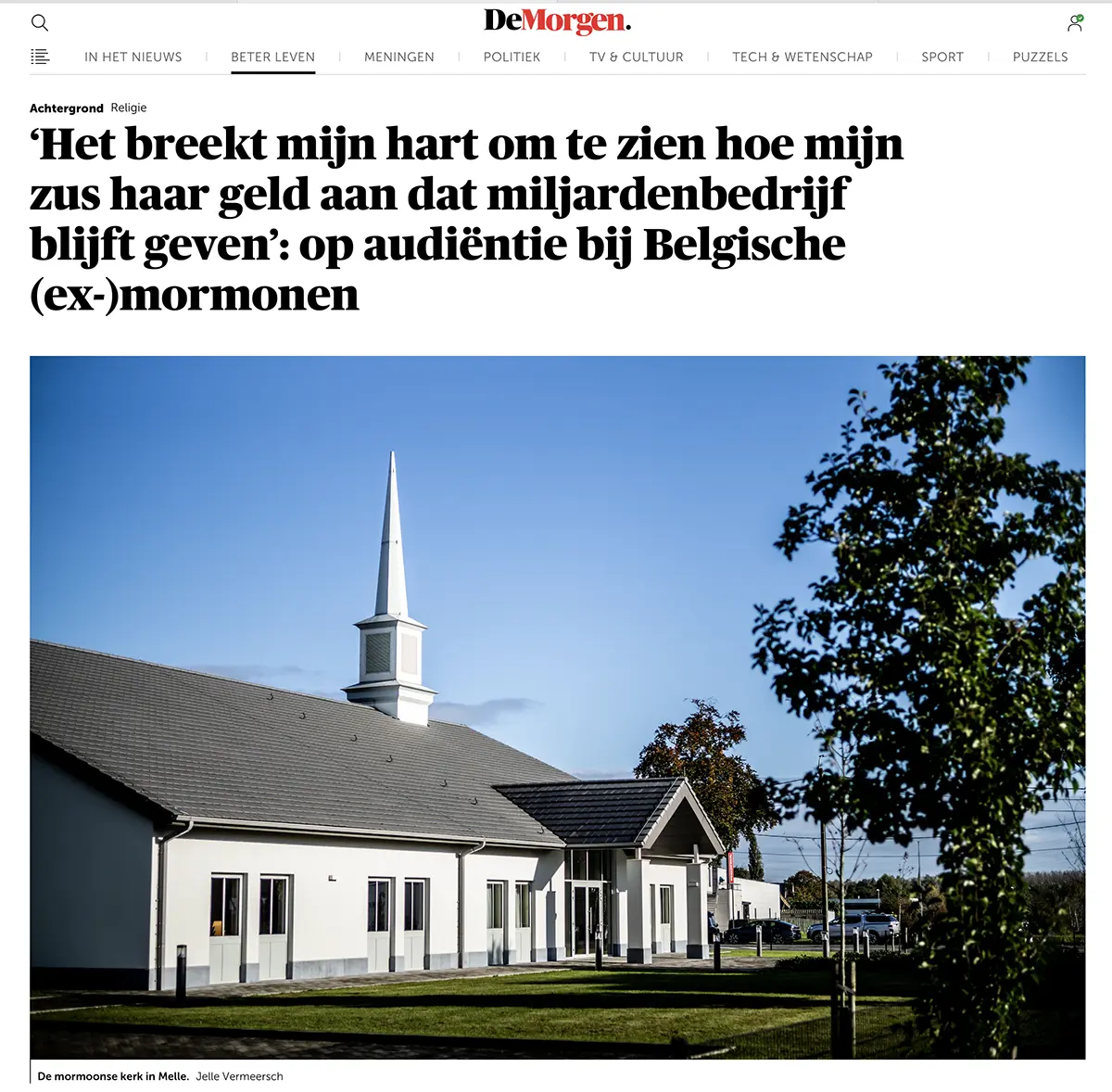
Recently appeared in Humo and De Morgen an article about The Church of Jesus Christ of Latter-day Saints in Belgium. As a bishop and as someone who has been a heartfelt part of this faith community for years, I feel the need to respond to this. Not only because the article paints a painfully incomplete and often incorrect picture, but also because the journalistic approach is, to say the least, questionable. I therefore want to clarify a number of things in this text and provide the necessary nuance that is completely missing in the original piece.
A matter of deontology
Let me start with the creation of the article. The text is partly based on an interview that spokesperson Stefaan van Gijsel and I gave. We answered the journalist's questions and afterwards, as requested, reviewed the text. That rendition was a correct summary of our conversation, here and there in the journalist's words, but broadly something we could agree with.
The unpleasant surprise only came with publication. What we were not told was that our answers would be presented to a number of ex-members, who then had the opportunity to respond to them, without any form of rebuttal from our side. The reverse never happened: we never had the chance to frame or correct their statements. The article gives the appearance of a balanced debate, with claim and counter-claim, but the reality is that it is a one-sided construction in which the critical voices get the lastword and their experience is presented as the objective truth.
This is ethically questionable. A journalist could have chosen to write an objective piece investigating facts, but here a setup has been chosen that places sensation above truth-finding. It is regrettable that the experiences of some disgruntled ex-members, however sincere their feelings may be, are used as an all-encompassing indictment against our church, while the context and the voice of active members are ignored. I can imagine that people who leave the church, often for personalreasons or misunderstandings, have a negative image. Sometimes these reasons are based on things they have misunderstood or that were never properly explained, or even on rumors that circulate but do not reflect the official doctrine or practice. Therefore, I find it essential to address the main accusations here, in full transparency.
The truth about our temple rituals

One of the most sensational claims in the article comes from an ex-member, Christina, who states that she was baptized for the dead in the temple, dressed in 'a white jumpsuit without underwear'. This statement is a painful mix of a little truth and a large amount fake news.
Let me first explain the truth. Yes, we perform baptisms for deceased ancestors in our temples. This ritual, which we call 'baptism for the dead,' is rooted in our deep belief in justice and the free will of every person, even after death. If you, hypothetically, assume that our church is the only true church of Christ on earth, then it would be unfair that billions of people who never had the chance to hear the gospel would be eternally condemned. That goes against the character of a loving andjust God. Therefore, we believe there must be a mechanism to offer everyone, regardless of when or where they lived, the same opportunities.
Baptism for the dead is one such mechanism. It is a vicarious act: a living member is baptized on behalf of a deceased ancestor. The crucial point, which is apparently often misunderstood, is that this is entirely optional for the deceased. One of the fundamental pillars of our faith is freedom of choice, and that also applies in the afterlife. When we perform this ritual, we offer our ancestors in the spirit world the choice to accept or reject this baptism. So you absolutely don't have to be ashamed because you had your atheistic grandfather baptized. If that grandfather in the afterlife discovers that there is more than he thought, it is still entirely up to him to say 'yes' or 'no' to that covenant. It is a beautiful, loving opportunity that we offer, not an obligation that we impose.
Now the assertion about the 'white jumpsuit without underwear'. This is unequivocally false. In our temples, which we consider sacred places, modesty is of paramount importance. Everything is done in white, as a symbol of purity and equality before God. Wearing underwear is not only permitted, it is mandatory. Furthermore, if someone has forgotten their own (white) underwear or stockings, these are provided in the temple to ensure that the ordinances are performed in a chaste and respectful manner. The notionthat this would be an indecent or uncomfortable event, is the absolute opposite of reality. If this had ever happened, it would have been a blatant violation of the rules, and I find it very difficult to believe that this would occur systematically as the article insinuates. This distortion of facts is a striking example of how the article operates.
Symbolism, Freemasonry and Revelation
The article also speaks of 'secret hand gestures' that would have been copied directly from Freemasonry. It is true that Joseph Smith, the founder of our church, was a member of the Freemasons. It is also true that there are similarities in the symbolism. But to dismiss this as plagiarism is a gross simplification.
Temple rituals are thoroughly symbolic. They use images and actions to convey deep, spiritual truths that are difficult to put into words. When Joseph Smith received knowledge about God's plan through revelation, it is only logical that he sought a symbolic language to structure and teach that knowledge. That he thereby used symbols and structures he was familiar with, such as those from Freemasonry, is not surprising.
Moreover, Freemasonry itself claims to have a tradition dating back to the builders of Solomon's temple. It is therefore not strange that ancient symbols appear in different places and in different traditions. For us, it is rather proof that these symbols are part of an ancient, divine truth that has been restored in our time. The fact that they appear in multiple places can just point to a common, ancient origin.
The suggestion that you must know these symbols perfectly by heart to get to heaven is also incorrect. We are taught that the symbolism must be understood in the heart, and that the Holy Spirit will bring to our remembrance what we need to know when it is needed. Help is always available in the temple for those who forget something. It is not an exam, but a learning process.
A Church of Questioners

Another persistent misconception is the claim that no questions may be asked within the church. Christina says: “The answer was always that asking questions was not appropriate”. I can only contradict this. Our church was founded by someone, Joseph Smith, who struggled with a deep question: which church was the true one? His search for an answer led to the foundation of our faith. Asking questions is essential.
How is it then that some members experience this differently? The answer lies in the unique structure of our church: we are a church of volunteers. The bishop, the Sunday school teacher, the youth leader – none of them have received professional theological training. We are ordinary people doing our best, with our own understanding of the gospel, to serve others. That mistakes are made in this process, that things are sometimes explained clumsily or incorrectly, is therefore unavoidable. It can happen that a local leader, out ofuncertainty or ignorance, dismisses a question because he or she simply does not know the answer and finds it difficult to admit that.
That's a shame, but it's not the policy or doctrine of the church. I myself constantly ask questions; it's by asking questions that I became a member because I found the answers here that I missed elsewhere. These answers don't always come easily. They require study, patience, and personal revelation. Religion is not fast food; it's a lifelong study. As a bishop, I will never turn anyone away with a question. Sometimes my answer is: “Give me time to figure this out”. And often my answer will be accompanied by the disclaimer:“This is what I have found, and this is my personal interpretation or feeling about it”. I will never, even as a bishop, proclaim my opinion as the absolute truth. We learn 'line upon line, precept upon precept'. The learning process never stops.
At the same time, the responsibility does not rest solely with the leaders. An essential part of our faith is the duty to seek answers ourselves, to study the scriptures ourselves and to pray for insight. Some people do ask questions, but are not willing to make the effort required to find a profound answer.
The position of women and the treatment of LGBTQ+
The article claims that women are ‘second-class members’. This is a painful and incorrect representation. We believe that man and woman are different, but absolutely equal. They are complementary and together form a unit in the family. Official declarations of the church literally state that man and woman are equal to each other. In leading a family, it is explicitly stated that man and woman do this together together, in consultation. There are worldwide organizations within the church led by women.
Do I deny that the church historically, just like society as a whole, had a more traditional role for women? No. And is our church sometimes slower in adapting to societal changes? Perhaps. But to claim that women are considered unimportant today is completely beside the truth. As a bishop, I greatly value the insights and help of the women who lead the ward with me.
The only point that remains, and which often leads to discussion, is that the priesthood is reserved for men. The question of why this is so may certainly be asked. The honest answer is: we don't fully know. God has not yet revealed the deeper reason behind this. This is one of those points where we must trust in God. But this does not detract from the fundamental equality of man and woman.
Regarding our stance towards LGBTQ+ people, it is more nuanced than the article suggests. The law of chastity is clear and applies to everyonesexual relations belong exclusively within a marriage between a man and a woman. What falls outside of this is not in accordance with the commandments. However, and this is a crucial distinction, having homosexual feelings or a homosexual orientation is not a sin in itself. I am the first to admit that this leads to difficult and painful situations for those involved. Our leaders, however, constantly emphasize that we must approach everyone with love and respect. As a bishop, I do everything I can to ensure thateveryone, regardless of their personal struggles, feels welcome and loved in our community. That mistakes are made by volunteers that hurt people is unfortunately inevitable and deeply regrettable.
Child protection and dealing with former members

One of the most serious and hurtful insinuations in the article concerns child abuse. Let me be absolutely clear about this: the church takes this extremely seriously. There is absolutely no culture of cover-ups. The suggestion that Stefaan's and my reactions are 'scandalous' is particularly painful, especially since the statements of the ex-members on this subject were never presented to us during the interview. We answered general questions about our policy, without knowledge of their specific allegations.
Yes, within a church of millions of people, there will unfortunately be individuals who make terrible mistakes and commit sins. The question is not whether it ever happens, but how you deal with it as an organization. And in that regard, I can state with certainty that our church does its utmost to protect children. The measures that the article cynically refers to are precisely proof of this. The glass doors in the classrooms? They are not there to hide a problem, but precisely to offer literal transparency andprevent abuse. The rule that at least two adults must always be present during activities with young people? That is a double protection, both for the young people and for the adult supervisors against false accusations.
There is a whole set of rules about transport, personal conversations, and camps. Everyone who works with young people must follow mandatory training and take an online test. As a bishop, it has been impressed upon me that at the slightest suspicion of abuse, I must not hesitate and immediately involve the civil authorities. It is true that these rules have evolved over time. We learn and try to do better and better. It is therefore particularly bitter that our efforts to take responsibility are beingframed as proof of guilt.
As for dealing with ex-members, there is no church policy that says we should cut off contact. On the contrary, we try to keep in touch with people who are no longer active, unless they themselves indicate that they no longer wish to do so. We respect that. For parents to cut off contact with their child is a personal tragedy, not a church doctrine. Because our church is a way of life for many, it can be very difficult when that common ground disappears, which can lead to diluted contacts. But that is a human phenomenon, not a church commandment.
Finances, recruitment and the so-called 'cult'
The article insinuates that we target 'vulnerable people' to easily collect money. This is an absurd and offensive claim. We believe we possess a message of eternal happiness, and it would be selfish not to share it with everyone. We make no distinction in doing so. The fact that people with a migration background are sometimes more open to our faith often has to do with their cultural background, where faith plays a more significant role.
The financial logic behind the accusation also makes no sense. If we were after money, we would target the rich, not the weaker members of society. A significant portion of our funds is actually used to help people in financial distress, so that no member has to suffer hunger or become homeless. Groups that are financially struggling will more often appeal for such help, not the other way around.
Then the amounts. I have never heard the figure of 230 billion euros mentioned. The amount circulating within the church is closer to 30 billion. Is that a lot of money? Yes. But our church is financially completely self-sufficient. We finance all our church buildings, temples, and worldwide operations with donations from our own members, through the Old Testament law of tithing, which everyone decides for themselves whether or not to follow. We are one of the first organizations on site during humanitarian disasters and take care of ourmembers in need. We are frugal because we have learned from periods of near-bankruptcy in our early history and because we believe we must prepare for difficult times. We have no leaders who fly in private jets or live in golden palaces.
Finally, the article's concluding statement: the church is a cult that controls everything. This is a lie. The entire foundation of our faith is freedom of choice. Even on complex moral issues such as fertility treatments, the church provides guidelines and advice, but the final decision always rests with the couple, in prayer and after personal inspiration. There is no thought control; doubt is allowed and can even be a driver for faith growth.
An invitation to an honest conversation
The portrayal of facts in the article is so distorted that I do not recognize myself or my faith in it at all. If the church were as described there, I myself could not be a member, because that is not who I am.
The many obligations spoken about do not exist. You are asked to help, to serve, to go on a mission. The 'new name' you receive in the temple is a sacred symbol of new life after death, which you may never even mention outside the temple – it is not a new identity.
This bothers me so much because it is so fundamentally untrue. That's why I hope everyone who reads this and has questions will take the trouble to search further. Talk to people who know the church from the inside, who have been active in it for years. Also listen to the experiences of ex-members, because their vision is part of the story. But don't let their word be the only or the last word. My door is open. If you have questions, you can ask them to me. I will not avoid any of them. Because only in an open and honestconversation, with respect for all parties, a more truthful picture can emerge than the caricatured portrait that has now been sketched. I sincerely hope that.
Discover more from GeensZins
Subscribe to have the latest posts sent to your email.
